











How dredger gold recovery changes with feed size variation
How Dredger Gold Recovery Changes with Feed Size Variation
Dredger gold recovery can change sharply when the feed changes from clean gravel to clay-bound sand, coarse cobbles, or a broad mix of particle sizes. The reason is straightforward: a dredging and recovery circuit is designed to move, classify, wash, and concentrate material within a workable range. When too much material sits outside that range, the system may still look busy while less gold reaches the final concentrate.
For the operator, feed size is not only a screening issue. It affects suction behavior, slurry density, screen loading, wash-water demand, jig or sluice performance, tailings discharge, wear, and downtime. In a dredger gold operation, stable recovery usually comes from matching excavation, screening, and gravity separation to the actual deposit rather than treating all river or placer material as the same.
Feed Size Begins at the Excavation Point
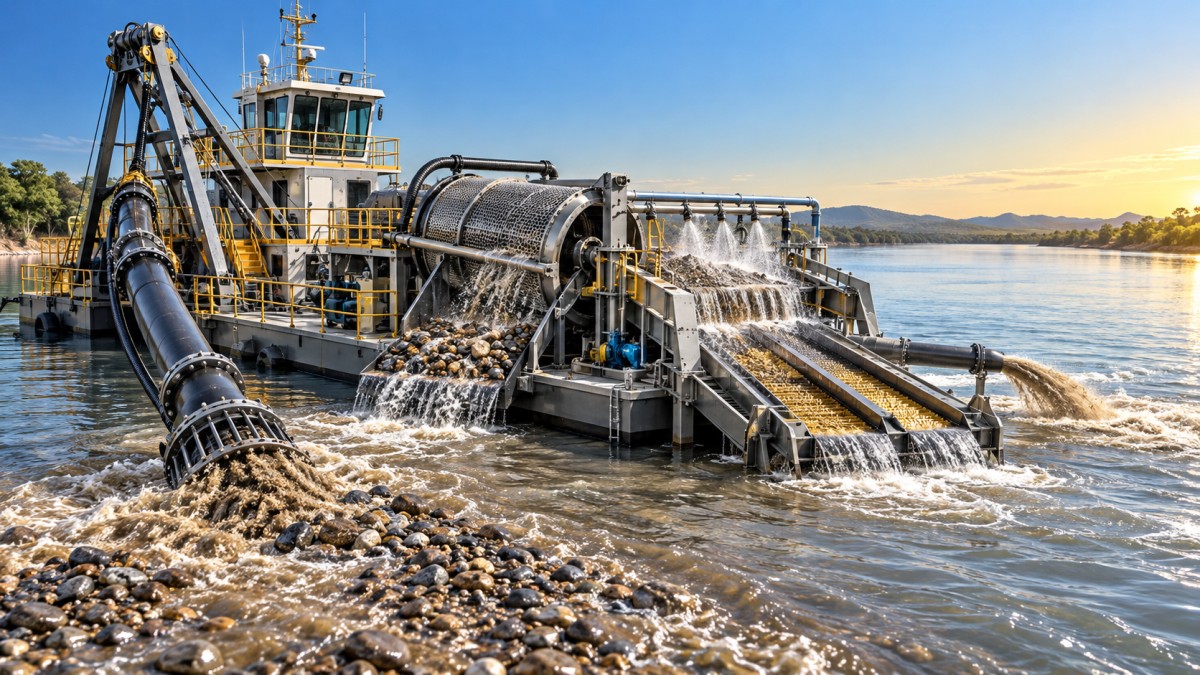
The material entering a gold dredger has already been influenced by the cutter head, bucket chain, suction inlet, or jetting arrangement. A suction system may draw fine sand efficiently but struggle when large stones block the inlet or repeatedly enter the pump line. A bucket-chain arrangement can handle coarser gravels more directly, yet oversized rocks can still overload the trommel or require manual rejection before the recovery circuit.
Operators should watch the feed at its source, not only at the end of the sluice. If the excavation face suddenly produces more cobbles, hardpan fragments, roots, or compacted clay, the plant settings that worked earlier in the shift may no longer be appropriate. A rising pump load, erratic screen discharge, or a visibly thicker slurry can all be early warnings that particle-size distribution has changed.
The practical objective is not necessarily to make all feed uniform. Natural placer deposits rarely allow that. The objective is to remove or control the fraction that prevents gold-bearing material from being properly washed and classified.
Why Oversize Can Reduce Recovery Before Separation Starts
Oversize rock has little value in most alluvial recovery circuits unless it carries attached or trapped fines. Its main effect is to consume capacity. Large stones occupy screen area, interrupt the movement of smaller material, and can cause the feed to bridge inside a hopper or trommel. When the screen cannot clear efficiently, fine gold-bearing sand may be carried forward with oversize or discharged too quickly without enough washing.
A larger screen aperture is not always the answer. Opening the screen may reduce blockage, but it also permits more coarse gravel into downstream equipment. That can disturb the bed in a jig, bury riffles, accelerate wear, and make concentrate cleaning harder. Conversely, a smaller aperture may improve downstream control but can become a production bottleneck if the material contains frequent cobbles.
The useful question is: what is the largest particle that the complete circuit—not just the first screen—can process without reducing washing quality? The answer depends on the dredger layout, pump capacity, classifier type, recovery equipment, and the character of the deposit.
Fine Material Has a Different Set of Risks
Very fine sand and silt may appear easy to process because they pass through screens quickly. In reality, an excess of fines can make recovery less predictable. Fine particles increase slurry viscosity, especially when clay is present. The slurry may no longer stratify properly in a sluice or jig, and fine gold may remain suspended long enough to leave with tailings.
Fine gold is particularly sensitive to water balance. Too little wash water can leave the bed compacted and prevent separation. Too much velocity can scour light or fine valuable particles from the recovery zone. The correct setting is therefore not simply “more water.” It is sufficient water to break up the feed and carry unwanted light material away while retaining a stable separation environment.
Where a deposit contains substantial fine material, crews often need to check whether the recovery circuit is suited to the expected gold size. A system arranged mainly for coarser visible gold may not capture fine particles reliably without a different finishing stage, improved classification, or more careful control of flow and feed rate.
Clay Is Not Just Another Fine Fraction
Clay deserves separate attention because it can hold gold-bearing sand in compact balls. A screen may reject these lumps as oversize, or the clay may pass through in partially broken form and release its contents too late for effective recovery. Sticky clay also coats screen openings, reduces open area, and changes slurry behavior from one hour to the next.
When clay is present, simply increasing feed rate usually makes matters worse. Better responses may include reducing the excavation rate, allowing more residence time in the washing section, adjusting spray or wash-water distribution, and inspecting screen surfaces more frequently. The aim is to liberate the mineral-bearing sand before gravity separation, not merely move clay downstream faster.
This is also why feed observation matters. A clean-looking tailings stream does not prove recovery is acceptable if clay-bound particles have carried unreleased values through the plant.
A Practical Operating Response to Mixed Feed
Mixed gravel is common in dredger gold work: coarse stones, medium sand, fine material, organic debris, and clay can arrive together. The most dependable response is controlled adjustment rather than one dramatic change. When feed becomes coarser, reduce the rate before changing screen size. When fines increase, check slurry condition and wash-water distribution before increasing pump speed. When clay appears, verify that it is breaking down before it reaches the recovery section.
A short operating log can be more useful than a complicated reporting system. Record the excavation zone, visible feed condition, screen behavior, water setting changes, concentrate appearance, and unusual tailings observations. Over several shifts, this helps identify whether poor recovery follows a particular layer, particle-size range, or operating setting.
- Inspect screen discharge whenever the material source changes.
- Check for rocks or clay balls carrying fine material into reject streams.
- Avoid raising feed rate just to compensate for a temporary drop in throughput.
- Review recovery equipment after any major change in screen aperture or slurry flow.
Support Equipment Also Affects Recovery Stability
Recovery performance is often discussed as if it depends only on the dredger and wash plant. On water-based projects, support logistics can have a direct operational effect. Delays in moving anchors, lifting a blocked pump casing, repositioning pipelines, or servicing the cutter head can push crews to operate under poor feed conditions longer than they should.
For example, the YLWB-600 Work Boat is configured with a 5T lifting crane and 3T anchor winch, providing support for tasks such as shifting anchors, handling pipelines, towing equipment, and lifting components that are impractical for the dredger crew to manage manually. Its 17m by 5.5m platform and 298kW power arrangement are relevant where maintenance access and dredger positioning must be handled safely in changing water conditions. The right support arrangement does not improve gold separation by itself, but it can help the recovery circuit stay within its intended operating window.
Choose the Circuit Around the Deposit, Not the Other Way Around
Before settling on a dredger gold configuration, it is worth understanding the deposit beyond average feed volume. Ask about the expected top size, the amount of undersize, clay content, gold particle size, water availability, and how quickly the material changes across the mining area. A brief representative sample program can be more useful than assumptions based on surface appearance alone.
Qingzhou Yongli Mining And Dredging Machinery Co., Ltd., established in 1997 in Qingzhou, Shandong Province, works across dredging vessels and water- and land-based mineral processing equipment. Its range includes bucket-chain, jet-suction, and cutter-suction gold or diamond dredgers, along with floating production platforms, washing equipment, and integrated processing lines. That broader equipment scope matters because feed-size problems are rarely solved by one component in isolation; screening, pumping, washing, recovery, and site support need to be considered as one working system.
When recovery shifts with changing feed, do not assume the gold has disappeared. Start by checking what has changed in the material stream, where classification is becoming less effective, and whether valuable particles are being released in time for separation. That disciplined approach usually gives operators a clearer next adjustment than chasing throughput alone.