












Why abrasive sand shortens the life of dredging equipment
Abrasive sand can quietly accelerate wear across pumps, pipelines, impellers, cutters, and other critical sand dredging equipment components. For after-sales maintenance teams, the damage rarely begins as a dramatic failure. More often, it starts with a small pressure loss, an unexplained vibration trend, a thinning bend liner, or a pump that no longer delivers its usual slurry volume. By the time production stops, the underlying erosion may have been developing for weeks.
Understanding how particle size, mineral hardness, solids concentration, flow velocity, and operating conditions interact is essential for preventing avoidable downtime. Sand is not simply “material being moved.” In a dredging circuit, it becomes a moving abrasive medium capable of cutting, impacting, and grinding metal surfaces throughout the system.
Sand does not wear equipment in only one way
Maintenance planning often becomes more effective when wear is classified by mechanism rather than by component. A pump casing, pipeline elbow, cutter head, and screen can all wear rapidly, but the reason for their failure may be different.
- Sliding abrasion occurs when fine, angular particles travel along a surface under pressure. It gradually removes material from pipe walls, chutes, liners, and pump passages.
- Impact erosion is more severe where slurry changes direction or strikes a surface directly. Impellers, volutes, pipe bends, reducers, valves, and discharge boxes are common impact zones.
- Gouging wear is caused by larger gravel, sharp fragments, or oversized rocks. This type of damage can tear liners, chip edges, and deform screens or cutter components.
- Corrosive-abrasive wear develops when water chemistry and abrasion work together. Once a protective surface is damaged, corrosion can progress more quickly beneath or around the worn zone.
A visual inspection tells part of the story. Smooth, polished thinning may suggest sustained fine-particle abrasion, while irregular pits, deep grooves, or localized holes often point to turbulent impact or recirculation. Recording these patterns helps a service team correct the cause instead of repeatedly replacing the same part.
Why particle shape and mineral content matter
Not all dredged sand has the same effect on equipment life. Rounded river sand generally moves differently from crushed sand, quartz-rich deposits, or mineral-bearing material containing hard gravel. Angular particles tend to cut more aggressively because their edges concentrate force against the metal or liner surface. Quartz is particularly important because of its hardness; even relatively small quartz particles can create persistent erosive wear under high slurry velocity.
For maintenance personnel, the practical question is not simply, “How much sand is being pumped?” It is also: What is in the sand? A change in borrow area, mining face, water level, or dredging depth may introduce coarser material, more silica, clay-bound gravels, or oversized stones. If the machine setup remains unchanged after the feed changes, wear rates can rise sharply.
Sampling the feed and comparing it with previous operating conditions can be more useful than waiting for a failed impeller to reveal that the material has changed.
Velocity: the operating variable that can turn normal wear into rapid erosion
Slurry needs enough velocity to keep solids suspended and avoid settling in pipelines. However, excessive velocity increases the energy with which particles strike internal surfaces. In practical terms, more speed does not always mean better output. A pump running beyond its efficient operating range can create turbulence, recirculation, heat, vibration, and accelerated wear at the same time.
Pipeline geometry has an equally strong influence. Elbows, tee connections, sudden diameter changes, poorly aligned joints, and abrupt transitions disturb slurry flow. The material does not distribute evenly through these areas; it concentrates against specific surfaces. A pipe may therefore look sound along its straight section while a bend develops dangerous wall thinning.
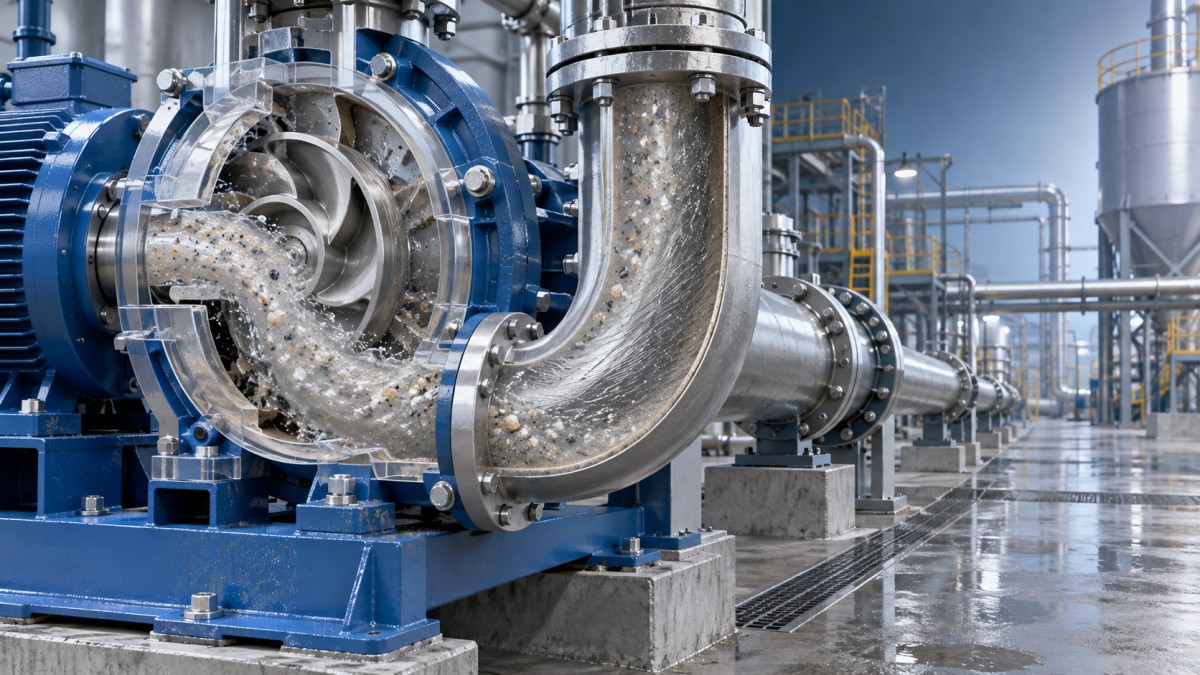
During inspections, pay close attention to the outside radius of bends, the throat area of pump casings, impeller vanes, suction liners, discharge reducers, and points immediately downstream of valves. Ultrasonic thickness checks are especially valuable where external inspection cannot reveal internal erosion.
High solids concentration is not automatically a productivity gain
Operators often aim for dense slurry because moving more solids per unit of water can improve production efficiency. But a slurry that is too dense may overload the pump, reduce flow stability, and create severe internal wear. When solids concentration rises beyond what the pump and pipeline were designed to handle, particles may settle, collide more frequently, and circulate inside the pump rather than passing cleanly through it.
This is where maintenance teams need operating data, not assumptions. Monitor discharge pressure, suction condition, pump speed, current or engine load, flow behavior, vibration, and changes in sound. A dull rumble, periodic knocking, or unstable pressure can indicate that the slurry transport condition has moved away from normal operation.
It is also important to distinguish between high-density slurry and poor slurry preparation. Material containing sticky clay can form lumps that carry embedded sand and gravel. These lumps may break apart unpredictably in pumps, screens, or washing equipment, creating intermittent overload and uneven wear.
Wear begins upstream of the dredge pump
Abrasive damage is often blamed on the pump because the pump is where the failure becomes obvious. Yet the root cause may start at the cutter, bucket wheel, suction head, or material preparation stage. A worn cutter head can lose its ability to loosen material efficiently, encouraging operators to increase suction force or pump speed. Oversized stones entering the intake can damage downstream components. Poorly controlled water addition may create either an overly dense slurry or excessive dilution that reduces transport efficiency.
The same principle applies in mineral recovery operations. In a plant processing clay-rich alluvial material, proper scrubbing and screening reduce the chance that compacted lumps and uncontrolled coarse feed will burden downstream equipment. For applications that combine dredged feed with gold recovery, a 300tph Gold Washing Plant can be configured with heavy-duty rotary scrubbing, trommel screening, and wear-resistant manganese liners to handle sticky clay, gravel, and boulders before recovery stages. This does not eliminate abrasive wear, but it helps make the feed more predictable and easier to manage.
A maintenance routine should focus on trends, not only replacement intervals
Fixed replacement schedules are useful, but abrasive conditions do not remain fixed. A component expected to last through a normal service interval may wear much earlier after a change in material gradation or operating practice. Conversely, replacing parts too early wastes serviceable life and increases maintenance cost.
A stronger approach combines planned inspections with condition monitoring:
- Measure and log wall thickness at repeatable points on pipes, bends, pump casings, and liners.
- Track pump pressure, power draw, vibration, and production rate together; one reading alone can be misleading.
- Inspect impeller clearance and wear-ring condition whenever pump performance drops unexpectedly.
- Check bolts, clamps, supports, and flexible connections, since vibration from worn hydraulic components can create secondary failures.
- Review cutter teeth, screen panels, intake guards, and grizzly spacing to control oversized material before it enters the slurry circuit.
- Keep a basic wear map showing where each part failed and what material was being handled at the time.
That last point is often underestimated. A simple record of wear location, operating hours, solids condition, and repair action can reveal recurring patterns. For example, repeated failure on one side of a pump or one section of pipeline may indicate misalignment, uneven flow distribution, or an unsuitable bend configuration rather than poor material quality.
Common maintenance mistakes that shorten service life further
One common response to reduced output is to increase pump speed immediately. This may restore flow briefly, but it can also accelerate erosion if the pump is already worn or the slurry is too abrasive. Another mistake is fitting a new impeller into a casing that has already lost its designed internal profile. The new part may not perform as expected because clearance and flow geometry are still compromised.
Using the wrong liner or alloy is equally costly. Wear-resistant materials should be selected according to particle size, impact severity, corrosion exposure, and the component’s function. A material that performs well in a straight pipeline may not be the best choice for a high-impact elbow or a pump throat area. Fitment quality matters as well: gaps behind liners can allow movement, cracking, and localized failure.
Finally, do not treat blockage clearing as a purely operational task. Repeated blockages can signal insufficient transport velocity, excessive solids, unsuitable particle size, or air entering the suction line. Each blockage event may expose the pump and pipework to abnormal load conditions.
Protecting sand dredging equipment is a system-level task
The longest equipment life does not come from one “stronger” part. It comes from matching the dredge, pump, pipeline, wear materials, and feed preparation process to the material being handled. For after-sales teams, the most useful role is often to connect field symptoms with system behavior: a worn bend may be a flow problem; a damaged impeller may be a feed-control problem; a recurring seal failure may be a vibration or alignment problem.
Qingzhou Yongli Mining And Dredging Machinery Co., Ltd. supports dredging and mining operations with equipment ranging from cutter suction dredgers and pump barges to sand washing and mineral processing systems. When abrasive sand conditions are evaluated early, maintenance teams can make more informed decisions on wear parts, operating limits, inspection frequency, and equipment configuration—before erosion turns into an unplanned shutdown.