











How to reduce delivery risk when planning dredge supply
How to Reduce Delivery Risk When Planning Dredge Supply
Planning a dredge supply project involves more than selecting the right vessel. A dredger may appear suitable on a quotation, yet delivery risk can emerge much earlier: the material profile was not fully defined, the transport route was assumed rather than checked, a customized component has a longer lead time than expected, or the site is not ready when equipment arrives. For procurement teams, these issues turn into idle labor, extended mobilization costs, and delayed production.
The practical objective is not simply to obtain the lowest initial equipment price. It is to secure a dredge supply arrangement that can be manufactured, shipped, assembled, commissioned, and supported within the project’s real operating constraints. That requires earlier technical clarification and a supplier evaluation process that goes beyond brochures and nominal capacity figures.
Start with the operating conditions, not the equipment list
Many avoidable delays begin with an incomplete request for quotation. “Need a dredger for sand” or “need a gold dredger” is rarely enough for a supplier to define a reliable configuration. The vessel type, pump arrangement, excavation system, separation circuit, installed power, hull dimensions, and spare-parts package may all change when the actual site conditions are known.
Before committing to a purchase order, document the material to be handled, expected particle sizes, clay content, gravel percentage, required digging depth, water level variation, shoreline access, power availability, and intended working hours. For mineral recovery projects, purchasers should also clarify whether iron ore is present in the feed and whether magnetic separation is required before gold, diamond, or zirconium concentration. These details affect both plant design and commissioning scope.
This is especially important where a standard platform is being adapted for a difficult deposit. A dredger designed for waterways with substantial clay and gravel may require different handling and separation choices from equipment operating in terrain with relatively low clay and gravel content. Treating those two conditions as interchangeable can create performance disputes after delivery rather than solving them before fabrication begins.
Assess supplier capacity as an execution question
A credible delivery plan depends on who controls the work between order confirmation and site start-up. Procurement teams should ask whether the supplier performs engineering, production, installation, and commissioning internally or relies on several disconnected parties. Neither model is automatically unsuitable, but fragmented responsibility needs clearer interfaces, schedules, and acceptance criteria.
Qingzhou Yongli Mining And Dredging Machinery Co., Ltd., established in 1997 in Qingzhou, Shandong Province, combines R&D, manufacturing, installation and commissioning, project operation, and personnel allocation services. Its range covers dredging vessels including cutter suction, bucket wheel, trailing suction, backhoe, jet suction, siphon, drilling suction, chain bucket, and amphibious dredgers, alongside work boats, pump barges, transport barges, floating platforms, and cleaning boats. That breadth matters when a project needs supporting equipment rather than an isolated vessel.
Still, range alone is not proof of readiness. Ask for a project-specific manufacturing schedule that identifies long-lead components, design approval points, factory inspection milestones, packing completion, and the proposed dispatch window. If a supplier cannot explain what must happen before the vessel is ready to ship, the stated delivery date may be only an estimate.
Turn customization into controlled scope
Customization is often necessary in dredge supply, but it is also where schedules become vulnerable. Changes to dredging depth, capacity, hull layout, discharge distance, recovery circuit, electrical system, or on-board accommodation can affect engineering, procurement, fabrication, and transport. The risk is not customization itself; it is approving changes without defining their commercial and timing consequences.
Use a written technical schedule as part of the purchasing package. It should identify the agreed operating duty, major equipment configuration, interfaces supplied by the buyer, and documents requiring approval. If site data are still uncertain, distinguish between fixed requirements and provisional assumptions. That gives both sides a basis for managing revisions instead of debating whether a late change was included in the original scope.
For example, a bucket-chain mineral recovery system should be selected around deposit conditions and recovery objectives, not solely around its rated throughput. Models such as YLBCGD-100, YLBCGD-150, YLBCGD-200, and YLBCGD-250 may be adapted for specified capacity and dredging depth requirements. In a suitable process arrangement, several gravity concentrators can be used to pursue a stated concentration ratio of up to 1:1000 and recovery efficiency of about 90%; actual results still depend on feed characteristics, operating practice, and the separation sequence. A useful starting point for reviewing that type of configuration is the Bucket Chain Gold Dredger specification.
Treat logistics as part of the equipment design
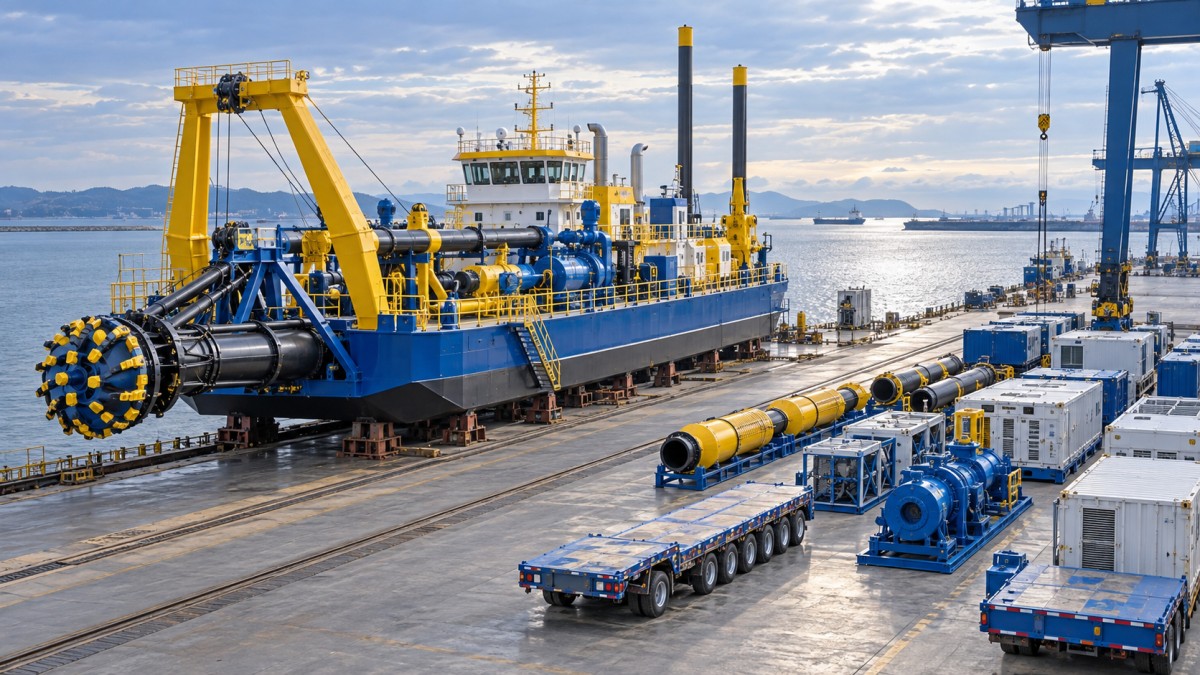
Dredgers are frequently modular, but “modular” does not automatically mean easy to deliver. Purchasers should establish whether the machine will move as completed sections, containerized components, or oversized cargo. The answer affects port handling, inland transportation, unloading equipment, site access, and the assembly sequence.
A sound logistics review should cover the nearest usable port or border point, road and bridge restrictions, lifting capacity at the destination, water access for launching, weather exposure during storage, and responsibility for customs documentation. It should also identify who supplies consumables and tools needed for assembly. Waiting for a crane, pontoon, generator, or welders after delivery can cost more time than a short delay at the factory.
Request a packing list early rather than at shipment. It allows the buyer to check whether containers, loose accessories, pipelines, pontoons, electrical cabinets, and spare parts can be received and stored safely. Each package should be traceable to an assembly drawing. This sounds administrative, but missing small connection parts can stop a large dredger from entering service.
Build acceptance and commissioning into the purchase order
A factory-ready machine is not necessarily project-ready equipment. Acceptance terms should separate factory inspection from site commissioning. At the factory stage, buyers may review the agreed configuration, main component identification, workmanship, documentation, and operational checks that can reasonably be performed before shipment. At site stage, the focus shifts to assembly, system integration, operator familiarization, and performance under actual conditions.
Avoid promising a site output number when the feed material, water conditions, and operator practices are outside the supplier’s control. A more useful approach is to define the commissioning tasks, the information required before the technician travels, the buyer-provided utilities and labor, and the method for recording any unresolved items. Where personnel allocation or project operation support is needed, clarify duration, language requirements, accommodation, visas, site safety rules, and local supervision well before shipment.
Compare total exposure, not just the quoted price
The lowest offer can become the most expensive if it excludes commissioning, critical spares, transport preparation, drawings, or support for a complex installation. When comparing bids, put each supplier’s scope into the same structure: equipment included, customization assumptions, delivery basis, packing, shipping responsibility, installation support, training, recommended spare parts, warranty boundaries, and payment milestones.
Payment milestones should reflect evidence of progress rather than calendar dates alone. Procurement teams commonly benefit from linking major payments to approved design information, identifiable production progress, completed inspection, and shipping documentation. The exact terms will depend on the contract and commercial relationship, but the principle is straightforward: payment, technical approval, and delivery evidence should not drift apart.
The most reliable dredge supply plan is usually the one that exposes uncertainty early. Confirm the material, lock the operating duty, map the transport route, define interfaces, and agree how factory completion becomes site operation. Those steps do not eliminate every disruption, but they give procurement teams a practical basis for protecting schedule and cost before the dredger leaves the workshop.