











How discharge distance affects sand dredging machine output
Discharge distance is one of the most consequential variables in sand dredging machine performance. A dredger may have adequate cutter power, a correctly sized pump, and a sound excavation plan, yet still miss its production target if the discharge line is longer, higher, or more restrictive than the hydraulic system was designed to handle. For technical evaluators, the question is not simply “How far can the slurry be pumped?” It is whether the machine can maintain the required solids production rate across the full operating distance without excessive fuel use, pipeline blockage, or accelerated wear.
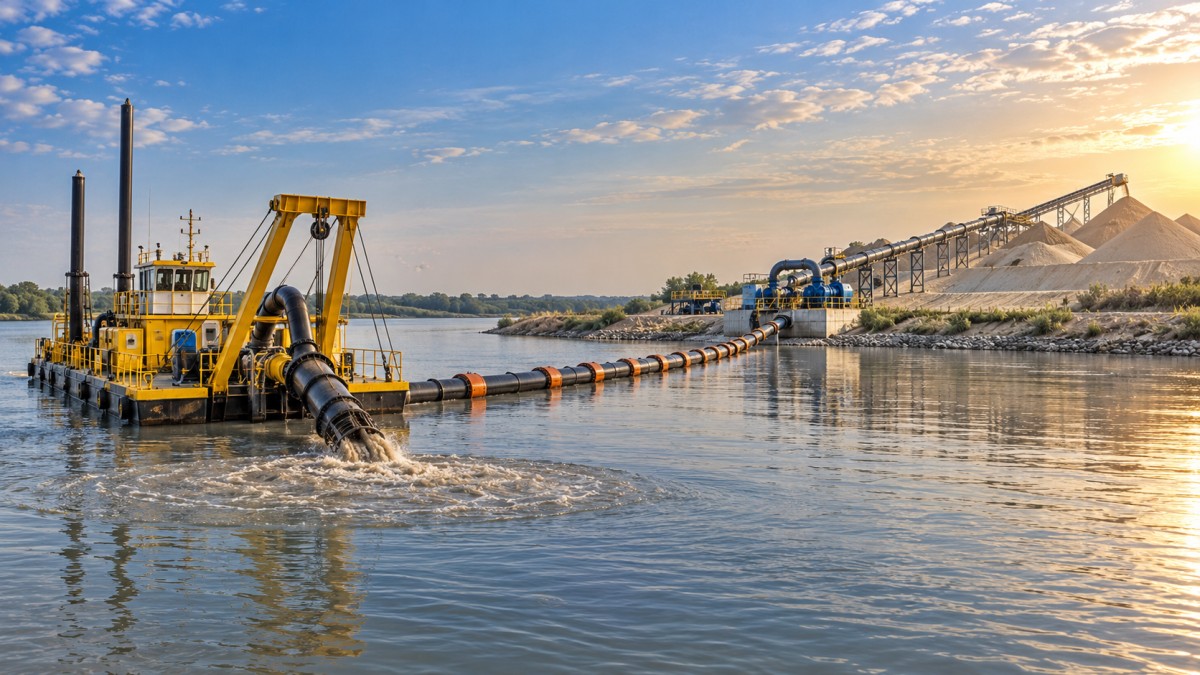
In practical sand extraction, discharge distance affects the balance between pump head, slurry velocity, line friction, elevation, and solids concentration. A sand dredging machine should therefore be assessed as part of a complete dredging system: dredger, pump, pipeline, booster arrangement where required, discharge point, and the material being transported.
Distance changes the hydraulic duty of a sand dredging machine
Every meter of discharge pipeline adds resistance. As sand-water slurry moves through a floating, submerged, or shore-based line, energy is lost through wall friction, bends, reducers, valves, hoses, joints, and changes in elevation. The dredge pump must supply enough total dynamic head to overcome these losses while retaining sufficient pressure and flow for stable material transport.
A simplified duty relationship can be expressed as:
Total Dynamic Head = Static Head + Pipeline Friction Loss + Local Losses + Required Discharge Pressure
Static head refers to the vertical lift between the pump centerline and the final discharge elevation. Pipeline friction loss rises with route length, slurry density, internal pipe condition, and velocity. Local losses are created by components such as elbows, flexible connections, manifolds, valves, and transition sections. In a real dredging project, these values change as the pipeline route changes, as wear enlarges the pipe bore, or as operators alter the water-to-sand ratio.
This is why a nominal pump capacity alone is not a reliable measure of output. A pump might deliver high water flow at low head, but a long-distance sand transport duty requires head capacity as well as flow. Once the operating point shifts too far along the pump curve, slurry flow can fall below the velocity needed to keep solids suspended.
What production loss looks like in the field
The effect of an extended discharge distance is usually gradual before it becomes disruptive. Operators may notice lower discharge density, more frequent cutter stoppages, rising vacuum instability, or a need to open more water to keep the pipeline moving. These measures can preserve transport velocity temporarily, but they often reduce the actual tonnes of sand delivered per hour.
In other words, a dredger can appear busy while producing less saleable material. The cutter continues to excavate, the pump continues to run, and the discharge line remains active, but the system may be transporting a more dilute slurry than planned. For projects measured by delivered volume, this distinction is critical.
- Short discharge routes generally allow higher solids concentration and lower energy consumption, provided the pump is not operating beyond its recommended range.
- Moderate distances require careful matching of pipe diameter, pump head, and slurry velocity. This is often the most common design condition for river, lake, and nearshore sand dredging.
- Long-distance routes may require larger pipeline diameters, a booster pump, staged discharge, or a revised placement area. Simply increasing engine speed is rarely a complete solution.
Velocity matters more than distance alone
Distance is a useful planning number, but it is not the only number that matters. The transport line must maintain a velocity above the settling threshold for the expected particle size distribution. If velocity becomes too low, coarse sand and gravel begin to settle at low points, bends, or sections with reduced slope. A partial deposit increases resistance; increased resistance lowers velocity further; the result can be a rapid progression toward blockage.
Conversely, excessive velocity is not automatically beneficial. It increases friction losses, fuel demand, pipe wear, hose abrasion, and stress at fittings. The appropriate operating range depends on sand gradation, specific gravity, solids concentration, pipe internal diameter, and the presence of shells, gravel, clay, or organic debris. Technical evaluation should focus on the critical deposition velocity and the planned normal operating velocity, rather than using water-flow figures in isolation.
Fine, uniform sand often behaves differently from mixed aggregate. A pipeline that performs well with clean fine sand may lose stability when the feed includes coarse particles or fluctuating clay content. Sampling the deposit and defining a realistic particle-size envelope are therefore essential before finalizing a discharge-distance calculation.
Pipeline diameter is a trade-off, not a universal upgrade
When discharge distance increases, specifying a larger pipe or hose bore can reduce velocity-related friction loss. However, a larger diameter also lowers slurry velocity at the same pump flow. If the flow is insufficient, the larger line may create a settling risk rather than solve it. This is a frequent error when an existing sand dredging machine is moved to a longer project without reviewing the pump curve and solids transport requirement.
The best diameter is the one that keeps the slurry within a safe transport velocity range while avoiding unnecessary head loss. Evaluators should compare several pipeline options against the proposed pump duty, not select the largest pipe available. The review should include the actual internal diameter after lining thickness, anticipated wear, and the restriction introduced by couplings or hose ends.
Floating lines can influence long-route reliability
For offshore reclamation, port maintenance, and dredging routes exposed to wind and swell, the floating section of the discharge line deserves the same attention as the pump. A line that twists, kinks, takes on water, or develops unstable sag sections can add unplanned resistance and interrupt production. The mechanical movement of the hose line is therefore connected directly to hydraulic consistency.
For applications requiring a flexible floating discharge connection, a Self Floating Rubber Hose can be considered within the line-design review. Its closed-cell foam buoyancy layer is intended to keep the hose afloat without external pontoons, while the rubber structure accommodates wave-induced bending. Depending on hose diameter and duty pressure, reserve buoyancy and abrasion-resistant liner thickness should be checked against the slurry density, sea state, flange loading, and expected operating hours. A floating hose is not merely a connection item; on a moving water surface, it is part of the transport system’s pressure-loss and reliability profile.
Elevation, bends, and route geometry often hide the real problem
A straight 1,000-meter route is hydraulically different from a 1,000-meter route with multiple sharp turns, a rising shore crossing, and several flexible sections. Each bend and transition creates additional losses. Sudden changes in pipe direction may also concentrate wear, especially where coarse sand impacts the outer radius of an elbow.
Route surveys should document more than horizontal distance. A useful technical package includes the discharge elevation, high and low points, pipeline profile, number and angle of bends, hose-to-pipe transitions, expected tidal variation, and the location of any booster station. Low points are particularly important because they can collect sediment after an unplanned shutdown. If the line cannot be drained or flushed effectively, restarting may demand more pressure than normal operation.
When a booster pump becomes the rational choice
There is no single discharge distance at which every dredger needs a booster. The decision depends on pump head, pipeline size, slurry characteristics, elevation, and target output. However, a booster should be evaluated when the main dredge pump cannot sustain both the required transport velocity and the desired solids concentration at the intended distance.
Adding a booster can restore pressure margin, but it also introduces control requirements. The dredge pump and booster pump must operate in a coordinated range. Poor matching may cause surging, excessive pressure, unstable density, or local overloading. Instrumentation such as pressure gauges at key points, flow measurement where practical, density monitoring, and engine-load trends provides the information needed to tune the system rather than operate by guesswork.
A practical review sequence for output estimates
Before accepting a quoted production rate, technical evaluators should request a system-level calculation based on the actual route. Start with the required delivered solids output, then define the material characteristics and intended slurry concentration. Confirm the dredge pump curve, impeller condition, suction arrangement, and available engine power. From there, calculate friction and local losses for the complete discharge line, including flexible floating sections and elevation changes.
The final check is operational: does the predicted flow remain above the deposition threshold with reasonable pressure margin? Can the system tolerate normal variations in feed density, pipeline wear, tide, and route movement? If the answer is only “yes” under ideal conditions, the design is likely too tight for continuous production.
Qingzhou Yongli Mining And Dredging Machinery Co., Ltd. supports dredging projects with equipment ranging from cutter suction and jet suction dredgers to floating platforms, pump barges, transport barges, and sand washing systems. For a sand dredging machine selection, evaluating the discharge distance as an integrated hydraulic and pipeline-design issue helps align the dredger configuration with the production target long before the first section of pipe reaches the water.