











What to inspect before buying a used sand dredger for sale
The purchase price of a used sand dredger is only the visible part of the investment. A machine offered at a substantial discount can become the more expensive option if its pump is worn, its hull has corrosion below the waterline, its diesel engine has been poorly maintained, or essential wear parts are no longer obtainable. The central question is not whether the dredger can start and move during a brief inspection; it is whether it can deliver the required solids production reliably under the material, water depth, and operating hours of the intended project.
A credible evaluation combines physical inspection, document review, performance verification, and a realistic estimate of post-purchase repair cost. These elements should be assessed together. A dredger with an older engine but complete maintenance records and available parts may be a safer acquisition than a newer-looking unit with an unknown operating history.
Confirm what the dredger was designed to do
“Sand dredger” covers very different equipment configurations. Before inspecting any used sand dredger for sale, define the required operating duty in measurable terms: target production rate, expected sand gradation, clay or gravel content, dredging depth, discharge distance, elevation lift, water conditions, and planned daily operating hours.
A cutter suction dredger configured for loose river sand may not perform acceptably in compacted material, gravel-rich deposits, or sites requiring a long slurry pipeline. Likewise, a small floating suction unit may be economical for shallow extraction but unsuitable for sustained commercial output. The seller’s quoted capacity should be treated as a design reference until it is matched against the intended material and discharge conditions.
Ask for the original technical specification, including pump diameter, installed power, cutter or suction arrangement, maximum dredging depth, pipeline size, and design discharge distance. If these documents are unavailable, record model numbers and nameplate data directly from major components. This is important because used dredgers are often modified over their service life, and the current configuration may differ from the original build.
Inspect the hull, pontoons, and structural connections
Hull condition affects safety, transportability, and repair cost. External paint can hide corrosion, patching, or deformation, so the inspection should go beyond appearance. Examine pontoons, hull plating, deck plates, welding seams, handrails, ladder supports, winch foundations, pump mounts, and connections between modular sections.
Particular attention is needed around areas exposed to continuous vibration or abrasion: the pump foundation, ladder pivot points, cutter drive supports, spud wells, and pipeline supports. Cracked welds, distorted plates, water accumulation inside pontoons, or repeated local repairs can indicate structural fatigue or inadequate past maintenance.
For a unit intended for export or relocation, also verify whether the dredger can be dismantled into transportable sections and whether lifting points are intact. A low purchase price can be offset quickly if oversized modules require special inland transport, extensive reassembly work, or replacement pontoons before commissioning.
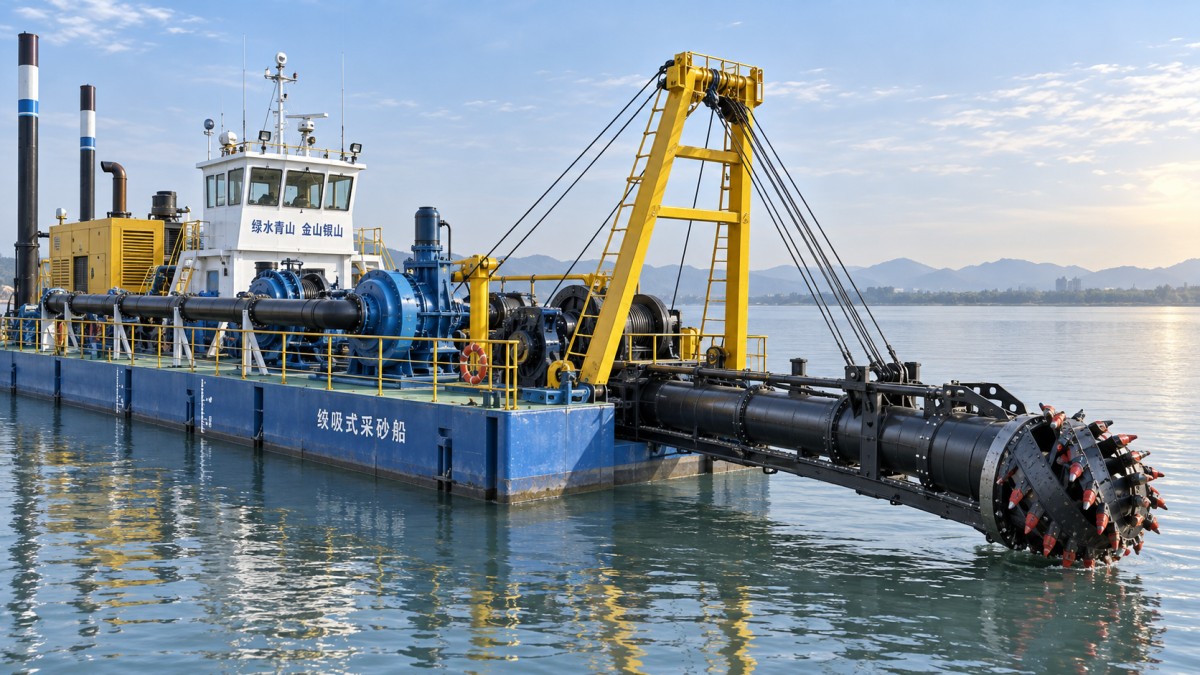
The dredge pump deserves the closest scrutiny
The slurry pump is normally the costliest wear-related risk on a used dredger. Its condition determines whether the machine can maintain slurry flow and solids output without excessive power consumption or downtime. A visual check of the pump exterior is not enough.
Where access is possible, inspect the impeller, volute liner, throatbush, suction liner, casing, shaft sleeve, seal arrangement, bearings, and coupling. Severe erosion, uneven wear, cracks, cavitation damage, or improvised weld repairs may indicate that the pump is near a major rebuild. Wear is expected in sand handling, but procurement decisions should distinguish between normal replaceable wear and damage that points to misalignment, poor suction conditions, or operation outside the pump’s duty range.
Request the pump’s service history, including the date and scope of the most recent overhaul. If the seller claims a rebuilt pump, clarify which parts were replaced and whether the work was completed by the original manufacturer, a qualified workshop, or an unknown third party. New paint on a pump casing is not evidence of renewed hydraulic performance.
A supervised operating trial is preferable. During the trial, observe suction stability, slurry discharge, pressure readings where fitted, bearing temperature, vibration, seal leakage, unusual noise, and engine load. The discharge should be assessed under a representative pipeline arrangement rather than only with a short open outlet. A system may appear productive in an easy test yet lose practical output once real discharge distance and elevation are introduced.
Check engine condition beyond hour-meter readings
Engine hours are useful only when they are consistent with maintenance records, wear condition, and the machine’s broader history. Hour meters can fail, be replaced, or provide no indication of idle time and overload operation. Inspect the engine serial number, maintenance labels, oil condition, cooling system, fuel system, exhaust behavior, belts, hoses, mounts, and electrical wiring.
Start the engine from cold where possible. Difficult cold starting, persistent smoke after warm-up, unstable idle, abnormal crankcase pressure, coolant contamination, or oil leaks around major seals warrant further investigation. If the purchase value justifies it, an independent engine inspection and fluid analysis can reduce uncertainty before contract signing.
Also establish whether the installed engine complies with the operating jurisdiction’s emissions, registration, or import requirements. Compliance obligations vary by country and project type, so an engine that is technically sound may still create avoidable clearance or operating restrictions.
Examine the ladder, cutter, winches, and positioning equipment
Dredging productivity depends on more than the pump. The ladder system must lower and raise smoothly, with limited play in pivots and reliable hydraulic cylinders or winches. Check pins, bushes, sheaves, wire ropes, hydraulic hoses, cylinder rods, and mounting brackets. Pitting on cylinder rods can damage seals and lead to recurring hydraulic failures.
For cutter suction units, inspect cutter teeth, hubs, gearboxes, motors, and protective guards. Missing or mismatched teeth can be inexpensive to replace, but damaged cutter drives or gearbox noise can signal a more serious repair. On dredgers using spuds, inspect spud straightness, wear surfaces, lifting mechanisms, and locking components. A worn positioning system reduces digging control and can delay operations even when the pumping system remains functional.
Verify electrical and control-system integrity
Older dredgers may have simple controls, but simple does not mean trouble-free. Control panels should be opened for inspection where safe and permitted. Look for corroded terminals, overheated cable connections, unlabeled modifications, moisture ingress, damaged gauges, and bypassed safety devices. Confirm that emergency stops, alarms, bilge pumps, navigation lights where applicable, and protective devices operate properly.
Replacement availability matters. A discontinued controller, non-standard electrical cabinet, or undocumented wiring modification can create long downtime after delivery. Obtain wiring diagrams, control-system manuals, and a list of installed electrical brands before committing to the purchase.
Maintenance records reveal more than a seller’s condition statement
A used unit does not need a perfect history, but it should have a traceable one. Useful records include operating logs, planned maintenance schedules, pump rebuild invoices, engine service reports, spare-parts lists, repair photographs, inspection certificates where applicable, and ownership history.
Gaps in documentation do not automatically disqualify a dredger. They should, however, be reflected in the risk allowance and contract conditions. If there is no proof of the last pump overhaul, no record of engine service, and no reliable indication of operating hours, the buyer is effectively purchasing a machine with an unknown remaining maintenance interval.
Parts support should be assessed at the same time. Identify wear components that will be consumed routinely: impellers, liners, seals, cutter teeth, screens, hoses, bearings, rubber joints, and pipeline fittings. Confirm part numbers, interchangeability, lead times, and whether the supplier can provide a recommended initial spare package. A dredger can be mechanically serviceable yet commercially impractical if one critical component has a long or uncertain replacement cycle.
Calculate the cost of making the dredger project-ready
The relevant comparison is not seller price against seller price. It is delivered, repaired, commissioned, and operating cost against expected usable production. The budget should include inspection travel or third-party inspection, dismantling, loading, freight, customs clearance, reassembly, commissioning, replacement of worn parts, pipeline additions, crew training, insurance, and contingency for defects discovered after arrival.
Pipeline requirements are frequently underestimated. A used dredger may be sold with limited floating pipe, damaged rubber hoses, worn couplings, or no suitable shore pipeline. If the project requires long-distance slurry transport, booster pumping and additional power may also be necessary. These costs can change the economics of a seemingly attractive machine.
Where the sand deposit includes recoverable heavy minerals or gold-bearing material, extraction and recovery should be evaluated as separate functions. A dredger moves slurry; it does not automatically provide effective mineral recovery. For mobile exploration, pilot work, or small deposits where washing and screening are required near the source, a separate modular unit such as a Movable Gold Trommel Washing Plant may be relevant to the processing layout. Its suitability depends on feed characteristics and recovery requirements, not on the dredger purchase alone.
Use the inspection findings to negotiate the contract, not merely the price
Inspection results should lead to clear commercial terms. List included components individually: dredger body, engine, pump, cutter or suction head, control cabinet, pontoons, anchors or spuds, winches, pipeline, tools, manuals, and spare parts. Avoid broad descriptions such as “complete set” unless the exact scope is attached to the contract.
Where an operating trial is possible, agree on acceptance criteria tied to observable conditions: successful start-up, functioning controls, stable pump operation, absence of major leakage, and the specified included equipment. Capacity guarantees require particular care because actual output depends on material, depth, pipeline resistance, and operator practice. A claimed hourly capacity should not be treated as a guaranteed project result unless the conditions behind it are explicitly defined.
A sound used dredger purchase is not one with the lowest upfront number. It is one where the remaining condition of the hull, pump, power system, positioning equipment, and parts supply is known well enough to forecast repair exposure and operating readiness. When those facts cannot be established, the appropriate response is not optimism; it is a lower risk-adjusted valuation or a decision to keep looking.