












How deck load limits affect safe Work Boat operations
A Work Boat can appear lightly loaded while still operating outside a safe deck-load condition. This often happens when a heavy pump, spare component, fuel container, lifting accessory, or recovered material is placed near one side, at the bow, or high above the deck. The total weight may seem acceptable, yet the vessel can develop excessive list, reduced freeboard, poor trim, or unstable motion when turning, towing, lifting, or working in waves.
Deck load limits affect safe Work Boat operations because they are not simply a maximum cargo number. They define how much weight the deck structure and the vessel’s stability condition can safely tolerate at a given location and operating state. Safe decisions therefore require checking total load, load distribution, center of gravity, securing method, deck strength, and the added effects of water, motion, and changing consumables. A load that is manageable at the berth may become unsafe once the vessel starts dredging support work, equipment transfer, or personnel transport.
Deck load is a stability issue, not only a structural issue
Every deck has a structural capacity. Excessive local loading can deform plating, overload supporting beams, damage welds, or create permanent weakness around equipment foundations. However, a Work Boat may become operationally unsafe before visible structural damage occurs. Weight placed above deck level raises the vessel’s vertical center of gravity. Weight placed off the centerline shifts the vessel’s center of gravity sideways. Both conditions reduce the vessel’s ability to return upright after external forces cause heel.
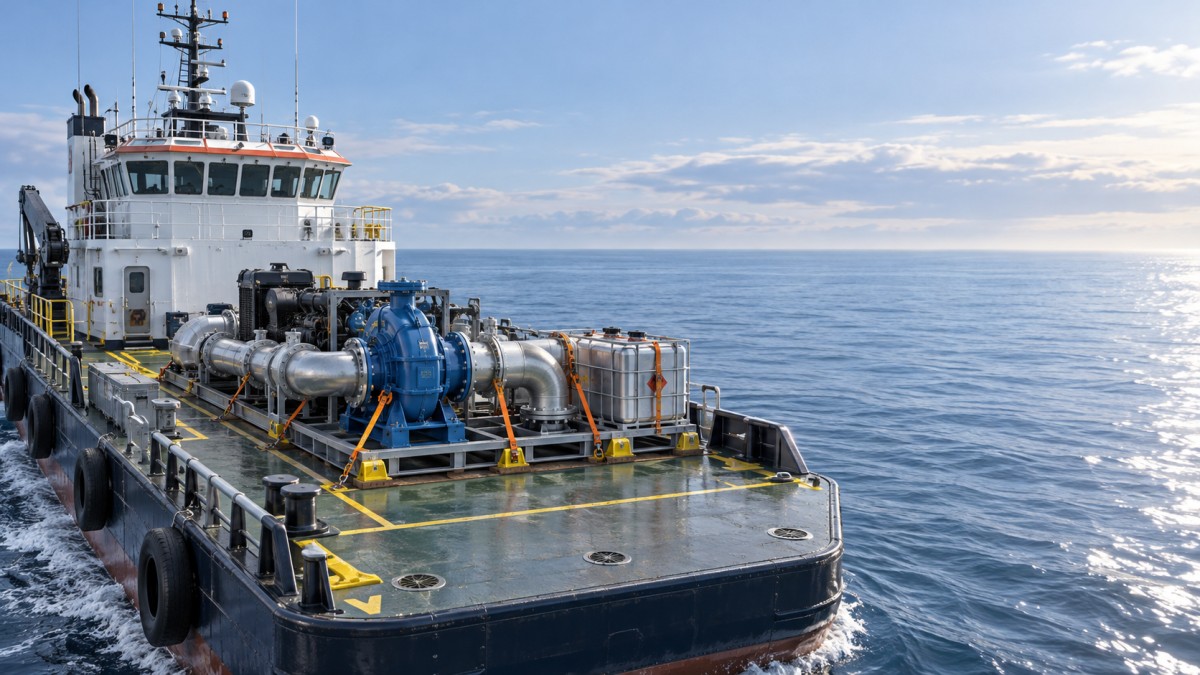
This distinction matters during routine decisions. A compact engine, winch, generator, toolbox, or skid-mounted pump may fit physically on deck, but its position can still produce an unacceptable heel angle or reduce the remaining stability margin. Similarly, several moderate loads grouped in one working area may create a local deck-pressure problem even where the overall vessel displacement remains within a planned limit.
Deck-load control should therefore answer two separate questions:
- Can the deck and its supporting structure carry this load at this exact location?
- Can the vessel safely carry the load in its expected operating condition, including motion, lifting, towing, and weather exposure?
Neither question should be assumed from the other. A structurally strong deck does not automatically provide adequate stability, and a stable vessel does not make an overloaded deck safe.
Where unsafe conditions usually develop
Risk commonly increases during temporary work rather than normal transit. A vessel may have a familiar equipment arrangement for most of the shift, then receive spare hoses, lifting gear, dredging tools, fuel drums, repair materials, or recovered samples without a revised loading check. The change can look minor because each item is familiar, but the combined effect may be substantial.
A second problem is uneven loading caused by work sequence. Equipment is often landed where it is easiest to access. Material may accumulate beside a hatch, near a crane reach, or along one rail. When crew members then gather on the same side to connect hoses or guide a lift, the list becomes more pronounced. Free surface in partly filled tanks can further reduce stability because liquid shifts as the vessel heels.
Water retained on deck deserves similar attention. Blocked drains, washdown water, rainwater, or slurry residue adds weight and can move freely. It is not merely a housekeeping concern. Standing water increases deck load, changes local traction, and can worsen heel when it runs toward the lower side.
Reading the load limit correctly
Deck-load information may be expressed as a total allowable deck load, a distributed load per unit area, a point-load restriction, or a combination of these. These values must be interpreted with the vessel’s approved operating information rather than treated as interchangeable figures.
A distributed-load rating does not mean that a heavy item can be placed anywhere. For example, a machine with small support feet can impose much greater pressure at each contact point than the deck is designed to accept. Load-spreading mats or engineered foundations may be needed, but they should only be used when their bearing area, stiffness, securing, and effect on deck drainage are understood. A loose timber layer placed under a heavy unit is not automatically an adequate load-spreading arrangement.
Dynamic forces can invalidate a berth-side judgment
Static weight is only the starting point. A Work Boat in motion is affected by roll, pitch, wake, current, acceleration, towline forces, and lifting movement. These forces can increase effective loads on securing points and shift a marginal stability condition into an unsafe one. A compact load that is properly restrained during calm-water transit may still need a different arrangement for exposed-water operation.
Lifting operations are particularly sensitive. As soon as a load is suspended from a crane, davit, or other lifting arrangement, its effective center of gravity can move outward and upward. The resulting heel is influenced by the suspended weight, boom radius, vessel trim, tank levels, wind, and movement of the load. Personnel should not use a general deck rating as approval for a lift; the lifting arrangement and vessel stability condition need separate evaluation.
Towing and pushing also alter the operating picture. A stern-biased deck load may reduce reserve freeboard aft, while a bow load can affect visibility, trim, and response to waves. If dredging hoses, anchors, or floating pipelines are handled from one side, the temporary side force and the deck load should be considered together rather than as unrelated issues.
A practical control sequence before loading
Load planning does not need to be complicated, but it should be deliberate whenever the arrangement changes. Start with the actual operational condition: fuel level, freshwater, ballast status, installed equipment, crew count, tools already on board, and any retained material. A nominal “empty deck” condition is rarely the real condition at the moment a new item arrives.
- Identify the load accurately. Confirm the weight, dimensions, support points, center of gravity where relevant, and whether the contents can move or retain water.
- Select the deck position. Prefer a low, central, structurally supported location. Avoid placing heavy equipment against rails, over unsupported spans, or where it blocks escape routes, drains, access hatches, or firefighting equipment.
- Check local and overall limits. Compare deck pressure and point loading with the approved deck information, then assess the vessel’s resulting trim, list, and stability condition.
- Plan restraint before movement begins. Securing points, lashings, chocks, cradles, and anti-slip materials must be suitable for expected motion. A load should not be landed first and “secured later” while the vessel is free to move.
- Recheck after loading. Observe list, freeboard, deck drainage, clearance around equipment, and any change in vessel response. Correct a poor arrangement before departure or before commencing work.
Equipment choices that change the deck-load calculation
Mining and dredging support work may require processing modules, pumps, separators, pipe sections, generators, or spares to be carried near the work area. Their operational value does not remove the need for a vessel-specific load review. A larger capacity machine can introduce higher deadweight, different support geometry, greater water demand, or a need for additional hoses and power equipment, all of which affect the deck arrangement.
For example, a Bucket Chain Diamond Dredger may be configured for capacities from 100 t/h to 250 t/h, with listed power ranges and water consumption varying by model. When associated equipment, gravity concentrators, hoses, or recovered material are staged on a support vessel, the review should cover the complete working package rather than only the main machine. Higher-capacity arrangements can create different transport and handling loads even when each individual component appears manageable.
Where material contains clay, gravel, or magnetic ore requiring separation steps, deck planning should also consider where temporary containers, magnetic separation equipment, sampling equipment, and wash-water handling will be located. The safest arrangement is often one that reduces repeated relocation of heavy items during operations. Each unplanned move creates another opportunity for asymmetrical loading, poor securing, or a blocked deck drain.
Signs that the loading plan should be stopped and revised
Immediate review is warranted when the vessel develops an unexplained list, loses expected freeboard, drains water slowly, shows excessive trim, or responds differently to turns and wakes. Other warning signs include deck deflection, damaged grating, new cracks around foundations, loose lashings, shifting cargo, or the need to stack equipment higher simply to preserve working space.
Operations should also pause when load weight is estimated rather than confirmed, when approved deck drawings or operating limits are unavailable, or when a planned lift has not been assessed for the actual vessel condition. These are not paperwork issues. They remove the information needed to decide whether the vessel remains within safe structural and stability boundaries.
Safe Work Boat loading depends on treating every deck change as a change to the vessel’s operating condition. Keeping heavy loads low and near the centerline, controlling local pressure, securing equipment for real motion, maintaining drainage, and reassessing the vessel after each significant change will prevent many overload and stability incidents before they develop on the water.