












Why fuel use varies so widely among dredging machines
Fuel consumption can vary dramatically among dredging machines, and the difference is rarely explained by engine size alone. Two dredgers working on the same river may burn very different amounts of fuel per hour—or, more importantly, per cubic meter of material delivered. For business evaluators, this affects tender pricing, operating margins, fleet planning, and the long-term economics of equipment selection.
The useful question is not simply, “Which dredger uses less fuel?” It is: “Which dredging system moves the required material, over the required distance, under actual site conditions, at the lowest total fuel cost per useful output?” That distinction matters because a machine with a higher hourly fuel rate may still be the more economical choice if it maintains production in dense sand, deep water, or long discharge pipelines.
Fuel use begins with the work the machine is asked to do
Dredging is an energy-intensive process because the machine is not only excavating soil. Depending on the system, it may be cutting, loosening, lifting, mixing, pumping, transporting, dewatering, and unloading material. Each step adds resistance and changes the fuel demand.
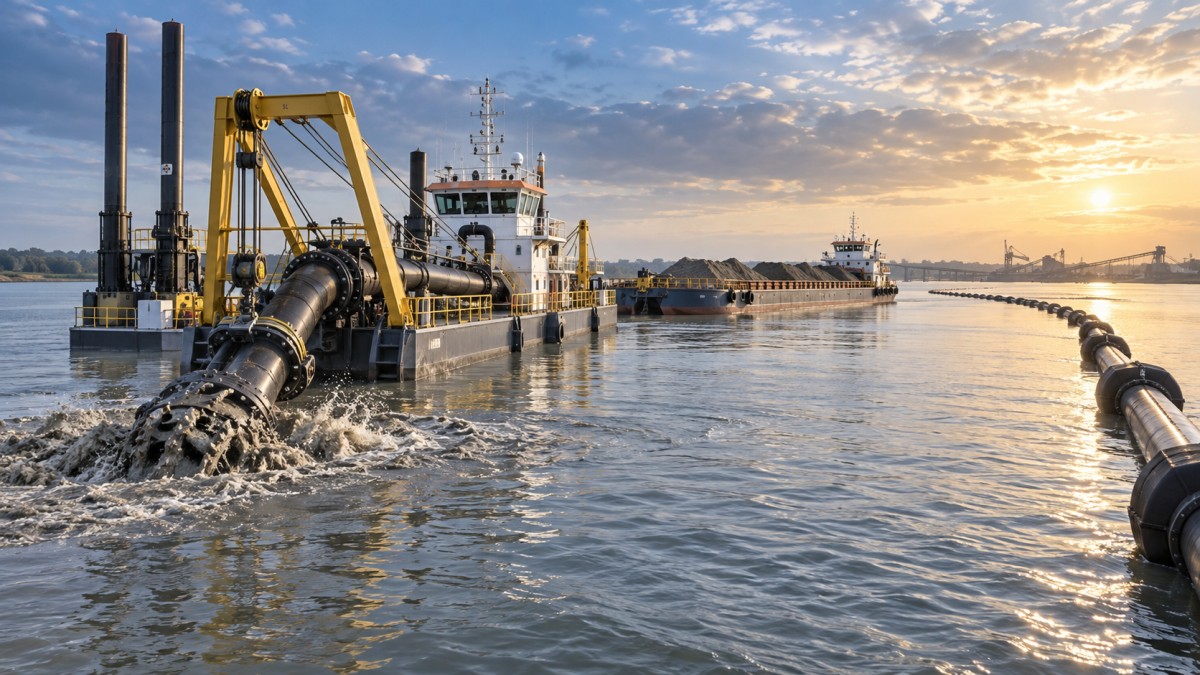
A cutter suction dredger, for example, needs power for the cutter head, dredge pump, hydraulic systems, winches, spuds, and often a booster pump. In soft, free-flowing sand, the cutter may need relatively little torque. In compacted sand, clay, gravel, or mixed material, the cutting load can rise sharply. If the material does not break efficiently, the operator may reduce swing speed, make repeated cuts, or run pumps below their most efficient operating point. Fuel is then consumed without a matching increase in output.
Other dredging machines have different energy profiles. A trailing suction hopper dredger uses substantial propulsion energy while sailing and dredging, but can be productive over large marine areas. A backhoe dredger concentrates energy in excavation cycles and usually relies on support barges for transport. A chain bucket dredger has continuous mechanical excavation requirements, while jet suction and siphon systems may have lower mechanical complexity but are highly dependent on material characteristics, water depth, and flow conditions.
Hourly consumption is only one number
When reviewing a supplier quotation or project budget, liters per hour can be misleading. A better comparison combines fuel use with production and transport performance:
Fuel intensity = total fuel consumed ÷ net cubic meters of usable material delivered.
“Delivered” is the key word. A dredger may excavate a large slurry volume, but if that slurry contains excessive water, loses solids in the pipeline, or requires extra handling before delivery, the apparent production figure can overstate project value. For sand mining, reclamation, or construction-material supply, evaluators should distinguish among in-situ volume, slurry volume, dry solids, and saleable or placed material.
A modestly powered system working near its hydraulic sweet spot can outperform a larger machine operating with an oversized pump, poorly matched pipeline, or frequent interruptions. Conversely, choosing a smaller dredger solely for lower engine consumption can become expensive when it repeatedly stalls in dense material or cannot meet the required delivery distance.
The biggest technical drivers behind fuel variation
1. Material density, particle size, and soil behavior
Fine loose sand, silty deposits, coarse aggregate, sticky clay, and mineral-bearing gravel do not behave alike. Dense solids require more excavation force and more pumping power. Coarse particles create greater pipeline friction and wear; clay can form plugs or reduce separation efficiency. In mining applications, a dredger handling gold- or diamond-bearing gravel may need a different excavation and washing arrangement than one moving river sand for construction.
Before selecting equipment, the project team should review soil investigation data, particle-size distribution, expected solids concentration, and the presence of debris, boulders, roots, or shells. These details have a direct connection to fuel planning, not merely to wear-part selection.
2. Pump duty point and discharge distance
The dredge pump is often the main fuel consumer. Pumping performance depends on flow rate, head, slurry concentration, pipe diameter, pipe length, elevation change, bends, and pipeline condition. Longer discharge lines and higher lift requirements demand more pressure. Every unnecessary bend, constricted hose, worn impeller, or poorly selected pipe diameter can increase energy losses.
A common procurement mistake is to compare pump power without comparing the full pipeline duty. A dredger that looks adequate on paper may require a booster pump in the field. A booster can be the correct technical solution, but it changes fuel consumption, maintenance needs, operator requirements, and project logistics. The right question is whether the complete dredging-and-discharge system meets the intended output at a sensible energy cost.
3. Water depth and excavation depth
Deep dredging does not automatically mean poor fuel efficiency, but it introduces additional load. The suction ladder position, submerged pump configuration, cable forces, spud handling, and required pipeline pressure all influence performance. As dredging depth increases, the operating window becomes narrower. A machine designed for shallow rivers may consume excessive fuel—or simply lose production—when used outside its intended depth range.
For shallow channels and sand mining reaches, hull draft is also part of the equation. A vessel that can access the working area without repeated grounding, waiting for tides, or relying on extensive auxiliary handling can protect both fuel usage and schedule reliability.
4. Operational discipline and downtime
Not all fuel is burned while producing. Idling during repositioning, crew changes, pipeline adjustments, barge delays, maintenance, or waiting for transport can quietly erode margins. In many projects, the difference between a well-managed dredging spread and a costly one is not the engine specification; it is the number of productive hours achieved each day.
Operators influence fuel results through cutter speed, swing pattern, pump rpm, ladder angle, and solids concentration control. Running at maximum power continuously is not always the fastest route to output. Stable feeding of the pump is usually more efficient than alternating between overload, cavitation, and low-density water pumping.
Transport can change the economics of the dredging spread
Fuel analysis should not end at the dredger. Where material must move from a riverbed or marine borrow area to a stockyard, reclamation site, or disposal zone, transport design can outweigh small differences in excavation fuel use. A dredger producing steadily will still lose money if barges are undersized, unavailable, slow to unload, or forced to carry unnecessary water.
For wet sand and aggregate logistics, a Sand Transport Barge with a cargo hold designed for dense, shifting bulk loads can support a more predictable material flow. Features such as drainage channels or filter screens may allow water to separate during transit, reducing deadweight and improving transit fuel economy. Shallow-draft hull forms are relevant in restricted rivers and tidal estuaries, while self-propelled and towed configurations should be evaluated differently: independent maneuverability may shorten transit cycles, whereas multiple towed barges can lower transport cost when routes and tug capacity are suitable.
Unloading method also deserves attention. Conveyor, screw, or grab-crane arrangements may require different onboard power levels, but faster unloading can reduce waiting time for both the barge and dredger. The lowest fuel-consuming component is not always the least expensive choice if it creates a bottleneck elsewhere in the system.
How to compare dredging machines during a commercial evaluation
A practical evaluation should request operating assumptions rather than rely on a single “fuel consumption” figure. Ask suppliers to describe estimated fuel use at stated production conditions, including material type, design dredging depth, discharge distance, pipeline diameter, target solids concentration, and whether transport or booster equipment is included.
- Compare fuel per cubic meter of net delivered solids, not only liters per hour.
- Separate dredging, pumping, transport, unloading, and auxiliary-generator fuel where possible.
- Review expected performance in both normal and difficult material conditions.
- Confirm whether the quoted output is continuous, peak, theoretical, or site-achievable.
- Include wear parts, maintenance downtime, crew requirements, and mobilization constraints in the cost model.
- Assess whether the equipment can be adjusted as water level, material quality, or discharge distance changes.
Manufacturers that integrate dredger design, installation, commissioning, and project-operation support can often help align these variables before mobilization. This is particularly valuable where a project combines excavation, mineral processing, floating production platforms, washing equipment, and barge transport rather than using a standalone dredger.
There is no universal “low-fuel” dredger
Fuel use varies widely among dredging machines because projects vary widely in material, depth, hydraulic distance, transport arrangement, and daily operating discipline. The most economical solution is the one whose cutter or excavation system, pump configuration, hull design, pipeline, and material-handling logistics work as a coordinated spread.
For procurement teams, the goal is not to find the lowest stated fuel number. It is to identify the configuration that converts fuel into usable, delivered material with the fewest interruptions and the least avoidable handling. That is the figure that ultimately belongs in a credible project cost forecast.