












How sampling results guide placer gold equipment selection
Selecting placer gold equipment from grade alone is a common and expensive mistake. A sample may show attractive gold content, yet the plant can still underperform if clay blinds the screen, fine gold bypasses the recovery circuit, oversized rock restricts feed, or the mining method does not match the deposit geometry. Sampling should therefore answer a practical question: what material will enter the plant, at what rate, and in what physical condition?
For technical evaluators, the most useful sampling result is not a single average value. It is a deposit profile that combines gold distribution, particle-size distribution, clay and organic content, gravel size, bedrock depth, water conditions, and variability across the proposed mining area. That profile determines whether placer gold equipment should be a land-based washing plant, a floating production platform, a jet suction dredger, or a cutter suction system with an appropriately designed recovery circuit.
Start with representativeness, not the assay result
A high assay from a shallow test pit does not necessarily represent an economic feed stream. Placer deposits are often layered: surface overburden, barren sand, pay gravel, compacted false bedrock, and natural bedrock may all occur within a short vertical interval. Gold can be concentrated in a narrow basal layer or trapped behind boulders and clay seams. Sampling that mixes these layers may dilute the apparent grade and hide where recovery should be focused.
Samples should be logged by depth and material type. Record whether each interval is loose sand, gravel, cemented material, sticky clay, boulder-rich feed, or bedrock-adjacent material. Map the sample locations across the planned mining block rather than relying on a few convenient points. This information helps determine both equipment capacity and the excavation or suction method needed to expose the pay zone consistently.
Grade still matters, but its role is to support a production decision after recovery behavior is understood. A lower-grade deposit with free, coarse gold and steady feed may be easier to process than a higher-grade deposit where much of the gold is ultrafine, locked in clay, or unevenly distributed.
Gold size distribution decides the recovery circuit
Sampling should identify where the gold sits within each screened size fraction. This is the result that most directly affects the recovery section of placer gold equipment.
Do not treat “fine gold” as one category. Flat flakes, flour gold, and gold held in clay behave differently in water. A useful test program includes size-by-size analysis and recovery trials on representative bulk material. The purpose is to establish a realistic recovery route, not simply to prove that gold is present.
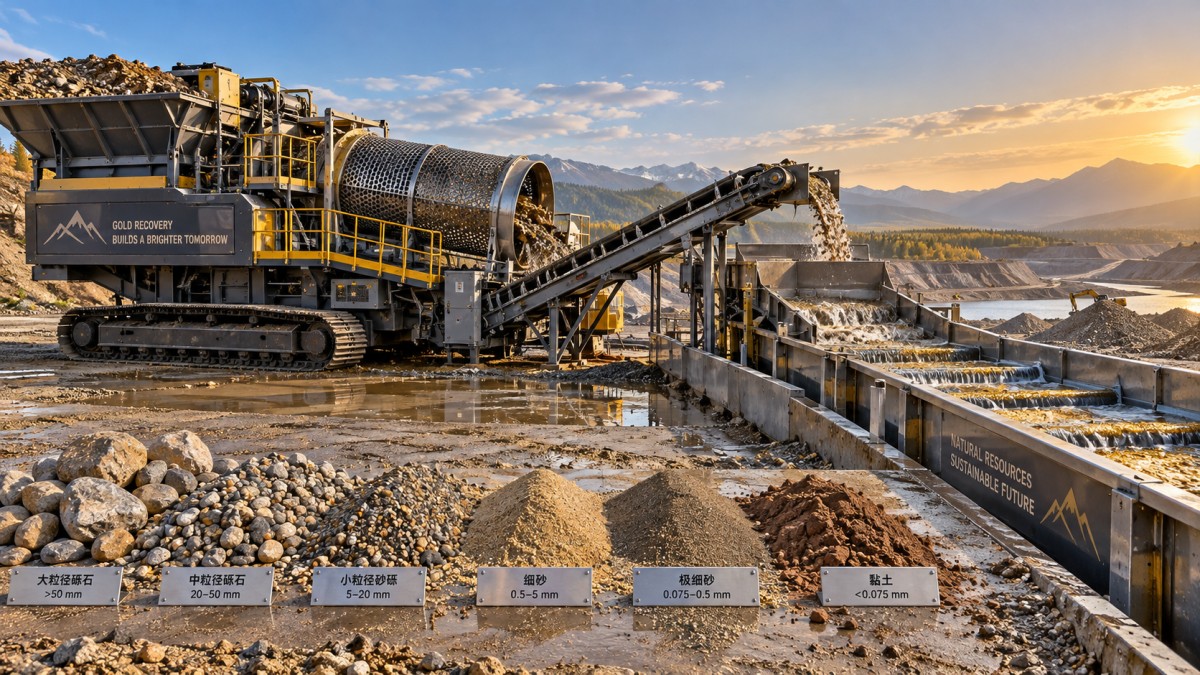
Clay content changes the plant more than many evaluations expect
Clay affects nearly every stage: excavation, slurry formation, screening, water use, and gravity separation. A trommel can be effective on clean alluvial gravel but may carry clay balls through the system if the material is not adequately broken down and scrubbed. Those clay balls can contain gold-bearing particles that never reach the recovery surfaces.
When samples show sticky clay or cemented fines, assess the degree of disintegration in water rather than recording clay only as a visual observation. Material that breaks down easily may need stronger spray bars and sufficient retention in the washing section. Persistent clay can require dedicated scrubbing, revised screen selection, or a lower feed rate. Increasing the nominal plant capacity does not solve a liberation problem; it can make screening and recovery less stable.
Water quality also matters. Fine sediment recirculation can turn process water into dense slurry, reducing washing action and altering separation behavior. Sampling and site inspection should therefore consider whether fresh make-up water is available, whether settling capacity is practical, and whether the chosen circuit can maintain stable water pressure during operation.
Use deposit geometry to choose the mining platform
The same recovery plant can be fed in very different ways, and the wrong mining method can become the production bottleneck. If the pay zone is accessible from dry ground and haul distances are manageable, a land-based washing plant may offer straightforward feed control. This is commonly suitable for palaeochannels, palaeo-riverbeds, and alluvial terraces where excavation can selectively target the productive horizon.
A shallow submerged deposit with loose material may favor a floating platform or jet suction arrangement. Suction performance must be matched to depth, material compactness, and the size of stones entering the intake. Loose sand and gravel behave differently from compacted basal gravels; the latter may need mechanical loosening or a cutter-assisted approach.
Where the deposit requires cutting through compacted layers or controlled excavation near bedrock, a cutter suction gold dredger can be more appropriate than a purely jet-based system. Conversely, a cutter system is not automatically the better choice for loose, shallow feed where its added complexity is unnecessary. Sampling records should show the thickness and hardness of each layer so that the equipment choice reflects the actual digging duty, not only the desired throughput.
Translate sample data into a plant specification
Before comparing quotations, turn the sampling program into a concise design basis. It should state the expected operating feed rate, maximum stone size, percentage of oversize, clay condition, target size range for gold recovery, heavy-mineral content, mining depth, water source, and expected variation between blocks. Suppliers can then size the hopper, feeder, screen aperture, trommel or scrubber, pumps, sluices, concentrators, and tailings arrangement around the same input conditions.
For example, a 100 t/h land plant is relevant only when the measured feed can be prepared and delivered at that rate without excessive clay, oversize, or dilution. The 100tph Gold Washing Plant is configured around a trommel screen, fixed sluice box, conveyor, and gravity concentration stages. It can be a logical reference for sampled palaeochannel, palaeo-riverbed, or alluvial feed where the intended production rate and water supply align with its configuration. Its listed water pump flow is 200 m³/h, so site water availability and recirculation design should be checked as part of the selection, rather than assumed after purchase.
Where raw material contains a high proportion of iron ore, planning magnetic separation ahead of gold, diamond, or zirconium concentration may