











When Custom Dredging Equipment justifies a longer lead time
A longer lead time for custom dredging equipment is justified only when it removes a material project constraint that a standard vessel would leave unresolved. The relevant question is not whether a custom machine has more features; it is whether its design changes throughput, availability, safety, or operating cost enough to outweigh the cost of waiting.
For a straightforward maintenance job in uniform, shallow water with predictable sediment, a standard dredger available sooner can be the better commercial decision. The calculation changes when the project involves variable depths, abrasive material, restricted access, unstable banks, demanding discharge distances, or a production target that a catalog configuration cannot reliably achieve. In those conditions, buying the quickest available machine can transfer schedule risk into years of inefficient operation.
Lead time is an engineering consequence, not a supplier preference
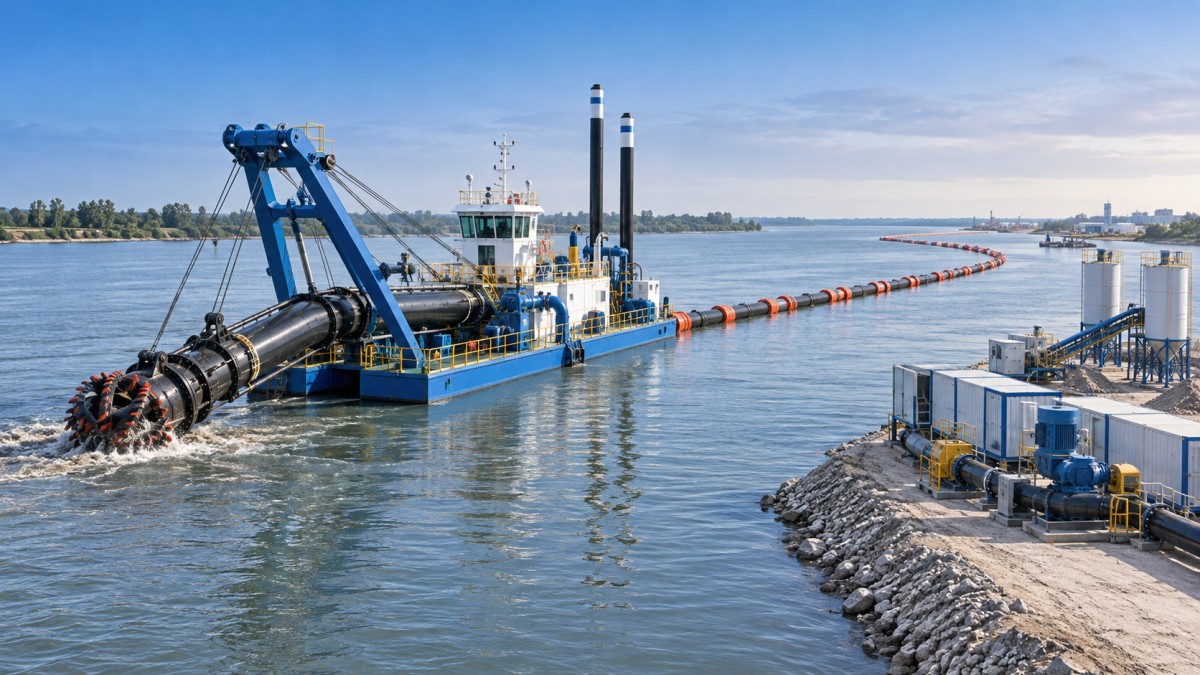
Custom Dredging Equipment takes longer because core design choices must be validated before fabrication begins. A change in dredging depth can affect the ladder arrangement, wire-rope system, pump selection, pontoon stability, and installed power. A longer discharge line may require a different pump curve, booster-pump provision, pipeline diameter, wear protection, and control logic. Material containing gravel, clay lenses, shells, or high solids concentrations changes the required cutterhead, suction arrangement, pump casing, impeller metallurgy, and power reserve.
These are connected variables. Specifying a larger pump without reviewing pipeline resistance and engine loading can create a machine that looks capable on paper but operates outside its efficient range. Similarly, increasing production capacity without considering spud force, swing geometry, or onboard flotation can reduce stability or create a bottleneck elsewhere in the dredging cycle.
A credible longer delivery schedule should therefore include time for site-data review, hydraulic and mechanical design, procurement of major components, structural fabrication, assembly, factory testing, and commissioning preparation. A short quoted lead time is not automatically an advantage if the quotation is based on untested assumptions about the site.
Where standard equipment commonly becomes a false economy
Standardized dredgers are valuable because they reduce design effort, spare-parts complexity, and delivery uncertainty. They are often appropriate where the excavation profile, sediment type, and working conditions fall within the vessel’s intended envelope. Problems arise when buyers treat nominal capacity as proof of project suitability.
The most frequent mismatch is between stated production and actual operating conditions. A supplier may state a theoretical volume based on an assumed suction depth, material mixture, discharge distance, and operating cycle. Field output can fall sharply when the material is denser or more abrasive than expected, when the discharge pipeline is longer, when water levels fluctuate, or when maneuvering space prevents an efficient swing pattern. A custom configuration is worth considering if it addresses one of these constraints directly rather than merely increasing installed horsepower.
Another costly mismatch occurs in constrained sites. A river channel, reservoir, mining pond, port basin, or tailings area may impose limits on transport dimensions, draft, bridge clearance, access roads, assembly space, noise, emissions, or shore power. Modular pontoons, a different propulsion system, adapted anchoring arrangements, or remote-control functions can be more valuable than a larger conventional hull. The benefit is not novelty; it is the ability to mobilize, work, and demobilize without repeated workarounds.
The cost comparison should include the operating year, not just delivery day
Procurement teams often compare the purchase price and promised shipment date first. Both matter, but neither describes the full financial exposure. The relevant comparison is between the lifecycle cost of a standard vessel and the expected lifecycle cost of a purpose-built one.
For a capital project, the main cost elements include:
- engineering and fabrication premium;
- additional time before the equipment can enter service;
- mobilization, assembly, and site adaptation costs;
- fuel or electricity consumption at actual duty point;
- wear-part consumption and maintenance labor;
- unplanned downtime and the cost of missed production;
- operator requirements and safety controls;
- residual value or redeployment potential after the original project.
A customized unit does not need to be cheaper in every category to be justified. It may cost more to build and take longer to receive, yet reduce fuel use per cubic metre, avoid frequent impeller and liner replacement, or eliminate the need for a separate booster station. More importantly, it can reduce the risk that a project fails to meet its intended production schedule. Where dredging supports mineral recovery, navigation access, flood control, or contracted material supply, lost operating hours can have consequences beyond maintenance expense.
The analysis should distinguish between expected downtime and catastrophic downtime. Routine replacement of cutter teeth or pump wear parts can be budgeted. A machine that repeatedly clogs, cavitates, lacks power reserve, or cannot hold position in the required working area creates a different form of risk: the project loses predictability. Customization has greatest value when it prevents that type of failure.
Customization is justified by defined conditions, not by a broad request for “higher capacity”
Vague specifications are a warning sign. “High output,” “deep dredging,” and “suitable for sand” are not adequate bases for a custom build. A supplier can only engineer a defensible solution when the buyer defines the duty conditions with reasonable precision.
The procurement file should identify the required excavation depth and its range, water depth, target production basis, material gradation, estimated solids content, particle size, presence of boulders or debris, discharge distance and elevation, available fuel or power, operating hours, weather exposure, transport restrictions, and expected project duration. For mining-related applications, the mineral-bearing layer, recovery process, and feed consistency also matter because dredging performance must match downstream washing or separation capacity.
Not every unknown must be eliminated before ordering, but critical uncertainties should be visible in the commercial and technical proposal. If material characteristics are uncertain, the quotation should state the assumed conditions and identify which components can be adapted later. This is preferable to accepting a broad performance promise that cannot be traced to a defined duty point.
Engineering flexibility can matter more than a bespoke hull
A fully unique vessel is not always the best form of customization. In many cases, a proven base platform combined with selected modifications offers a better balance between lead time and project fit. Examples include a configurable pump package, interchangeable cutterheads, modular pipeline sections, reinforced wear zones, a longer ladder, additional winch capacity, tailored electrical controls, or a barge layout designed around local transport constraints.
This approach limits design risk because critical systems remain based on established configurations. It can also improve spare-parts planning. A highly specialized machine may solve an immediate problem but become difficult to support if it relies on non-standard components without a documented supply route. The commercial objective is not maximum uniqueness; it is the minimum necessary deviation from standard design to secure reliable operation.
The same logic applies to ancillary waterway equipment. A debris-management requirement does not automatically justify a complex multi-purpose dredger. Where floating waste, vegetation, and access limitations are the main constraints, a dedicated Cleaning Boat with automated collection, a drainage-oriented storage area, and maneuverable thruster propulsion may be operationally more rational than modifying a dredging vessel for a task it was not designed to perform. Separating functions can shorten maintenance interruptions and keep production equipment focused on excavation.
How to test whether the extra lead time has commercial value
The decision should be tested against a realistic alternative: the standard machine that could be delivered sooner. Ask what the standard unit would require to complete the same work. Would it need more operating hours, additional pipeline support, a booster pump, a separate work boat, repeated repositioning, more frequent wear-part replacement, or an additional vessel during high-demand periods? These additions are often omitted from the initial price comparison.
Then ask what happens if delivery is delayed. If the work window is fixed by water levels, permit conditions, contractual commitments, or seasonal access, a longer lead time may create a material opportunity cost. In that situation, customization should be limited to elements that clearly protect production or compliance. Conversely, if the equipment will operate for several years or be redeployed across similar sites, a longer initial schedule can be acceptable because the design benefits extend beyond one campaign.
A useful procurement discipline is to require two comparable proposals: a baseline configuration and a custom configuration. Both should state the assumed material, discharge conditions, output basis, power source, included auxiliaries, commissioning scope, exclusions, warranty boundaries, and recommended critical spares. The comparison should identify not only price and delivery date, but also the operating condition under which each machine is expected to perform. Without this discipline, a low-cost standard offer and a higher-cost custom offer are not genuinely comparable.
Delivery risk deserves the same scrutiny as equipment capability
A custom order creates dependency on the manufacturer’s engineering control, component sourcing, quality inspection, and commissioning capacity. Buyers should review whether the supplier can explain the design basis, provide drawings and component lists appropriate to the contract stage, define inspection points, and document factory testing. Video inspection and mechanical test reports can support transparency, but they do not replace agreement on acceptance criteria.
Acceptance should be tied to measurable requirements that reflect the agreed duty conditions. These may include dredging depth, discharge arrangement, pumping performance, installed components, safety systems, electrical configuration, and documentation. Performance claims should clearly distinguish factory verification from site performance, since site output depends on material and operational variables outside the factory environment.
A longer lead time is justified when it buys a machine that fits the actual work, reduces dependence on improvised site modifications, and makes operating performance more predictable. It is not justified when “custom” merely means optional accessories, poorly defined capacity claims, or a design change unsupported by site conditions. The strongest procurement decision is usually neither the fastest vessel nor the most elaborate one, but the configuration whose added engineering solves a clearly quantified operational constraint.
