











What operating data to compare when evaluating a Yongsheng dredger
Start with a duty profile, not a brochure comparison
A technical evaluation of a Yongsheng dredger should begin with the conditions it must work in: material gradation, in-situ density, target cut depth, discharge route, water level variation, production target, and operating schedule. Without that baseline, comparing installed power or nominal cubic metres per hour produces a misleading result.
The central question is whether the dredger can sustain the required production under the site’s limiting conditions. A machine may achieve a high output in loose sand over a short discharge line, then fall well below target when handling compacted material, a deeper cut, a longer pipeline, or variable water levels. Ask suppliers to state the conditions behind every headline performance figure and compare all candidates on the same basis.
For a Yongsheng dredger evaluation, the most useful data set usually combines hydraulic performance, excavation performance, energy use, availability, and the practical limits imposed by the hull, pipeline, and support equipment.
Compare slurry flow and solids production separately
Slurry flow is often the first number shown on a dredger specification, but it is not the same as saleable or placed material output. A pump moving a large volume of water may look productive while delivering a low solids concentration. Assessors should request both slurry flow and expected solids throughput for the proposed material condition.
The comparison should include pump flow, discharge pressure or head, pipeline diameter, solids concentration, particle-size range, and the density assumption used in the calculation. If production is expressed as cubic metres per hour, establish whether it means in-situ volume, loose volume, dry solids, or total slurry volume. Those definitions can change the apparent capacity substantially.
Also examine the operating point on the pump curve. A pump that operates close to its best-efficiency region under the intended pipe length and elevation is usually a stronger choice than a larger pump selected only for its maximum flow rating. The latter can waste power, accelerate wear, and become difficult to control when conditions change.
Pipeline calculations deserve particular attention where the discharge line includes bends, floating hose, booster stations, shore crossings, or elevation changes. A dredger can be correctly sized for the cutter and still underperform because the transport system was treated as an afterthought.
Match the excavation tool to the material, not the nominal capacity
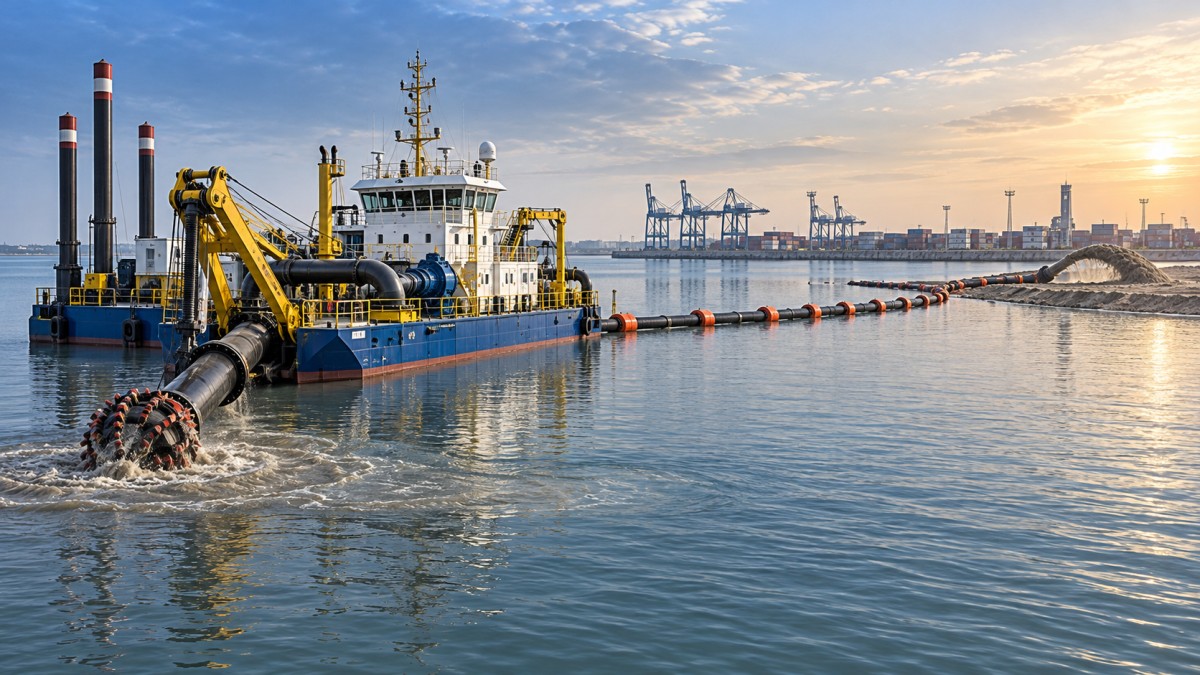
For a cutter suction configuration, the cutterhead’s torque, rotational speed range, tooth arrangement, and available power determine whether material can be loosened continuously without overloading the hydraulic system. Cutter power alone is incomplete data. A high-power drive is of limited value if the geometry, tooth selection, and swing pattern do not suit the actual soil or sediment.
Request the stated material assumptions behind the output estimate: loose sand, silty sand, clay, gravel-bearing material, compacted fill, or mixed debris are not interchangeable. In abrasive material, wear life of the cutter teeth, liners, impeller, suction liner, and pipeline should be included in the production model. Frequent component replacement affects both cost and uptime, even when the machine’s theoretical output remains attractive.
Bucket wheel, chain bucket, backhoe, and other dredging arrangements require the same discipline. Compare bucket fill factor, digging cycle, cut thickness, digging force, and expected spillage or rehandling. Their quoted capacities should be tied to a defined duty cycle rather than a peak figure achieved under ideal feeding conditions.
Depth, reach, and water-level tolerance are operational constraints
Maximum dredging depth is useful only when the machine can maintain a stable and efficient cut at that depth. Assess the working depth range, ladder geometry, suction pipe arrangement, spud length, winch capacity, and hull stability together. The target depth may be technically reachable but slow to maintain if ladder angle, vessel trim, or anchoring geometry restricts normal operation.
Water-level variation can be equally important. A dredger intended for a river, pond, reservoir, or nearshore operation should be evaluated at high and low operating water levels, including how pipeline connection, mooring, access, and discharge elevation change. A configuration that works well on a static water body may need different spuds, pontoons, anchors, or shore-side support in a current or fluctuating waterway.
Where the project has narrow channels, obstacles, or restricted turning space, manoeuvrability belongs in the comparison. This is especially relevant when dredging is paired with surface cleanup. For example, a thruster-driven Cleaning Boat may be evaluated separately for collecting floating waste or aquatic vegetation around the work area, but its collection capacity should not be combined with dredging production figures. These are distinct work scopes with different loading and availability assumptions.
Fuel use must be tied to output and operating mode
Fuel consumption in litres per hour is not enough for a meaningful comparison. Calculate fuel use per cubic metre of defined solids moved, then review it across likely operating modes: normal excavation, hard-material cutting, pipeline flushing, repositioning, standby, and low-production operation. A dredger that appears efficient at full load can become costly when the project spends substantial time in reduced-load conditions.
The engine, gearbox, hydraulic drives, dredge pump, auxiliary pumps, and electrical loads all contribute. Assessors should ask for a load balance rather than assuming installed engine power equals usable dredging power. Reserve power matters, but excessive oversizing can reduce part-load efficiency and increase capital cost without improving the project result.
Powertrain choices also affect maintainability. Clarify the service intervals, lubricant requirements, spare-parts list, filter access, cooling arrangement, and whether routine inspection can be completed safely while the vessel is afloat. These details have a direct effect on operating time and should not be deferred until commissioning.
Measure availability through the causes of downtime
Availability is more useful than a broad reliability claim when it is broken into likely downtime categories. For each proposed dredger, estimate time lost to cutter or bucket wear, pump wear, blockages, pipeline moves, spud moves, anchor handling, fuel transfer, inspection, and planned maintenance. Some losses are project-dependent, but they still need to appear in the production forecast.
A practical comparison asks how long common service tasks take and what equipment is required to perform them. Replacing an impeller, clearing a blockage, changing cutter teeth, or handling a floating pipeline can require cranes, workboats, divers, or shore access. A lower purchase price can be offset quickly if routine interventions are difficult at the intended site.
- Ask for the wear components expected to require regular replacement in the proposed material.
- Confirm whether spare impellers, liners, seals, teeth, hoses, and critical electrical or hydraulic parts can be stocked before mobilisation.
- Review access points, lifting provisions, guard design, and isolation procedures for common maintenance work.
- Separate planned maintenance hours from unplanned stoppages in the project production model.
Use one comparable operating case before making a selection
The most defensible way to evaluate a Yongsheng dredger is to give each candidate the same operating case: defined material, required depth, discharge distance and elevation, production target, working hours, and expected water conditions. Then compare delivered solids per operating hour, fuel per unit of output, wear exposure, anticipated availability, and the equipment needed around the dredger to keep it productive.
That approach often reveals that the best configuration is not the one with the largest headline capacity. It is the unit whose pump, excavation tool, hull arrangement, and support system remain balanced when the job moves away from ideal conditions. For a technical assessor, that is the data comparison that turns a specification review into a selection decision.
