












How feed rate affects recovery in a mining concentrator
Feed rate has a direct and often non-linear effect on recovery in a mining concentrator. Raising throughput can increase production, but only while the separation circuit still has enough residence time, hydraulic capacity, and bed stability to capture the target mineral. Once that operating window is exceeded, recovery commonly falls before the operator sees an obvious mechanical failure.
For an operator, the practical question is not simply whether the plant can accept more tonnes per hour. It is whether the concentrator can process that material at the required feed size, slurry density, water flow, and mineral liberation condition without allowing valuable particles to bypass the separation stage.
Why higher feed rates can reduce recovery
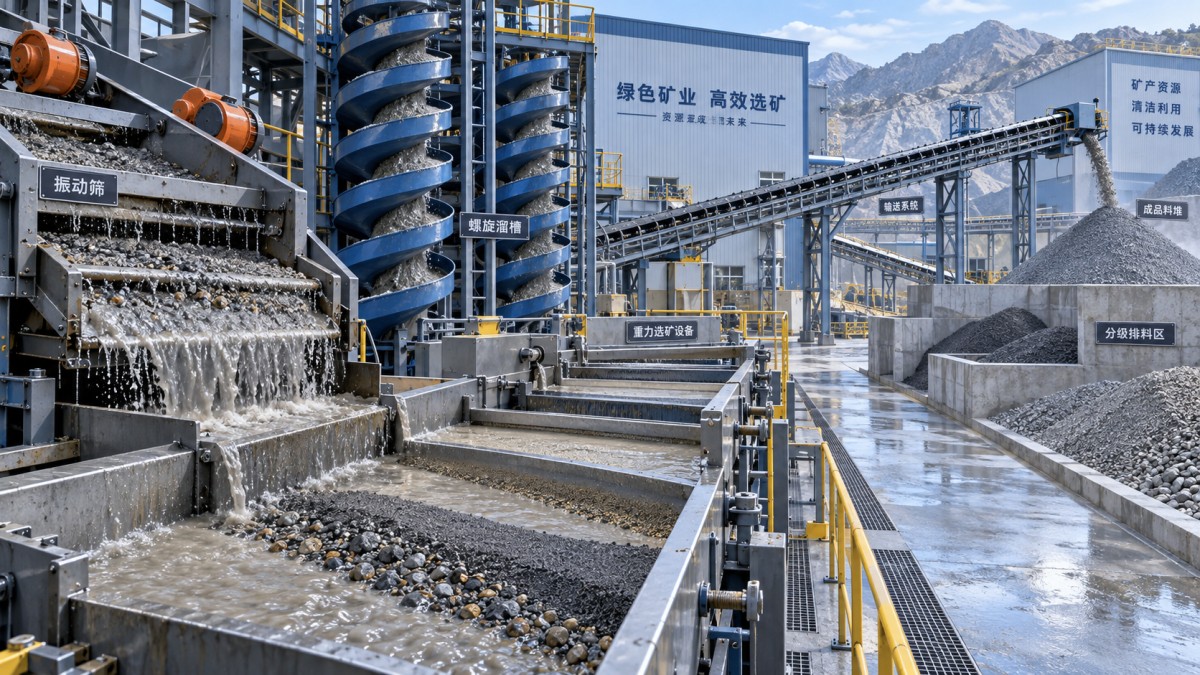
Every concentrator has a working capacity. In gravity circuits, screens, jigs, spirals, sluices, shaking tables, centrifugal concentrators, and similar equipment all depend on a controlled relationship between particle mass, water flow, and available separation area. A higher feed rate changes that relationship.
When solids loading rises too far, the slurry layer becomes deeper or denser, particle movement becomes less selective, and lighter gangue may carry valuable heavy minerals out with tailings. Fine gold, small diamonds, zircon, and other liberated high-density minerals can be particularly vulnerable when the circuit is overloaded. Larger particles may still report to concentrate, creating the misleading impression that recovery remains acceptable while finer value is being lost.
Overfeeding can also increase turbulence. In a gravity separator, some movement is necessary to stratify particles by density and size. Excessive flow or an uneven feed can disturb the separation bed, scour previously captured material, and shorten the time available for settling. The result may be a higher tonnage reading with lower recovery per tonne and a lower overall value recovered.
A feed-rate increase is therefore beneficial only when the rest of the circuit can absorb it. This includes feed preparation, classification, water supply, discharge capacity, and concentrate handling. A bottleneck upstream or downstream of the main separator can make an apparently reasonable throughput target unworkable.
Feed rate is more than tonnes per hour
Operators often discuss feed rate as a single number, such as tonnes per hour. That number matters, but it does not fully describe the load seen by a mining concentrator. A plant may receive the same dry tonnage while operating under very different separation conditions.
- Particle-size distribution: A feed containing more fines presents far more particles for the separator to handle. Fine material can consume water, blind screens, increase slurry viscosity, and reduce the opportunity for dense particles to settle.
- Clay content: Clay changes the slurry behavior. It can bind fine values to gangue, form agglomerates, reduce screening efficiency, and interfere with gravity separation. A rate that works on clean gravel may overload the circuit when clay-rich material enters the feed.
- Slurry density: Two feeds with identical tonnage can have very different water-to-solids ratios. Excessively dense slurry restricts stratification; overly dilute slurry may raise hydraulic loading and wash material through too quickly.
- Feed consistency: Sudden surges are often more damaging than a steady rate near the design limit. A separator adjusted for stable conditions cannot respond instantly to a large slug of coarse gravel, clay, or water.
- Mineral liberation: Increasing the feed rate does not compensate for poorly liberated material. If valuable minerals remain locked in oversize, clay balls, or composite particles, the separation stage cannot recover what has not been adequately exposed.
For this reason, an operator should compare recovery against both dry-feed rate and feed condition. A drop in recovery after a production change may be caused by more difficult material rather than the throughput figure alone. Conversely, a plant may tolerate a higher rate after improved washing, desliming, or classification because the separator receives a cleaner, more uniform feed.
What overload looks like before recovery data confirms it
Recovery measurements are essential, but they may arrive after valuable material has already been lost. Day-to-day operating signs can indicate that the concentrator is moving beyond its efficient range.
- Screen decks show persistent pegging, blinding, or excessive carryover.
- Feed distribution becomes uneven across a sluice, jig, spiral bank, or other separation surface.
- Water adjustments become increasingly frequent without restoring stable operation.
- Concentrate mass rises sharply, but final concentrate quality does not improve.
- Tailings appear coarser, denser, or visibly richer in heavy minerals than under stable conditions.
- Equipment power draw, pump pressure, or sump level becomes erratic because the circuit is cycling rather than operating steadily.
These signals do not automatically prove a recovery loss. They do indicate that sampling and inspection should be brought forward. In many plants, the most useful check is a timed, representative comparison of feed, concentrate, and tailings across two controlled rates. The comparison should keep water settings, screen condition, and feed source as consistent as possible. Changing several variables at once makes the result difficult to interpret.
Finding the useful operating window
The best feed rate is usually a range, not a fixed maximum number. Within that range, the plant maintains stable separation while meeting a practical production target. The upper end should be set by verified recovery performance, not by the maximum rate that conveyors, pumps, or dredging equipment can physically deliver.
A disciplined rate test can begin below the expected limit, then move upward in measured steps. At each step, allow the circuit to stabilize before collecting samples or assessing concentrate behavior. Record dry tonnes, water use, screen performance, slurry condition, separator settings, concentrate mass, and tailings observations. Where laboratory assay or mineral accounting is available, use it to confirm the operating choice. Visual inspection alone is especially unreliable for fine gold and fine heavy minerals.
Throughput decisions in dredging and placer operations
In dredging-based recovery, feed-rate control begins at excavation as much as at the concentrator. Bucket speed, dredging depth, gravel character, clay content, and water availability all influence the material delivered to the washing and recovery plant. Increasing excavation rate can introduce more raw material, but it can also send larger surges of gravel and clay into the screening and gravity circuit.
For a bucket-chain operation, the relationship between dredging capacity and concentrator capacity should be reviewed as one system. A unit such as a Bucket Chain Gold Diamond Dredger may incorporate several gravity concentration stages and be configured around a required depth and production capacity, but the rated capacity alone does not guarantee the same recovery across all deposits. Clay-rich waterways and cleaner gravel deposits impose different loads on the washing and separation sections.
Water consumption deserves the same attention. Adding water can help transport and wash material, but unrestricted water flow can also increase velocity through recovery equipment and carry fine values into tailings. The correct adjustment depends on separator type, feed size, solids density, and the behavior of the target mineral. Operators should avoid treating more water as a universal correction for a rising feed rate.
Recovery should guide the production target
A concentrator producing fewer tonnes at a consistently higher recovery may deliver more payable mineral than a circuit pushed to its maximum mechanical capacity. The relevant measure is recovered value over the operating period, not throughput in isolation. This is particularly important where feed grade varies, because a small recovery loss on higher-grade material can outweigh the benefit of additional tonnes.
The operating discipline is straightforward: stabilize the feed, establish the recovery range at several controlled rates, monitor tailings whenever conditions change, and treat clay, fines, water balance, and feed surges as part of the feed-rate decision. Once those conditions are controlled, increasing throughput becomes a measured production choice rather than a gamble with recovery.
