











When dredge gold operations need onboard gravity concentration
Onboard gravity concentration is worth considering when a dredge gold project is losing recoverable value through long material transfers, unstable feed conditions, or delayed separation after excavation. It is most useful where gold is sufficiently liberated or can be liberated by washing and scrubbing, and where the dredger can supply a reasonably consistent feed to the recovery circuit. It is less effective when most of the value is locked in hard rock, carried in persistent clay balls, or present as extremely fine particles that the selected gravity equipment cannot retain.
For a project manager, the decision is not simply whether gravity recovery can be installed on a dredger. The question is whether integrating screening, classification, and concentration onboard will improve payable recovery enough to justify the added weight, water demand, maintenance workload, and operating discipline. A dredger that excavates more material does not automatically produce more gold. The recovery plant must handle the material characteristics created at the cutter, bucket chain, or suction intake.
When onboard recovery changes the project economics
An onboard circuit has a clear operational advantage when moving untreated dredged material to a shore-based plant is costly, slow, or exposes the project to avoidable losses. Hauling large volumes of gravel and sand merely to recover a relatively small heavy-mineral fraction can consume vessel capacity, fuel, labor, and time. Concentrating on the floating platform reduces the mass that needs further handling and allows the crew to monitor recovery while dredging continues.
This arrangement is particularly relevant where the deposit is shallow enough for continuous dredging, but access to stable land processing infrastructure is limited. It can also suit operations where the payable fraction includes coarse or medium free gold associated with gravels, black sands, or other dense minerals. Gravity separation works by exploiting density differences; it needs feed preparation that lets particles behave independently. If the feed arrives as compact clay lumps or overloaded slurry, the separator is receiving a problem that began upstream.
There is another reason to concentrate onboard: grade control. When the production team can compare recovered concentrate, oversize, tailings observations, and dredging location during the same operating shift, it can react more quickly to changing ground. A shore plant introduces delay. By the time poor recovery is noticed, the dredger may have moved through a higher-value section of the deposit.
That benefit depends on disciplined sampling and reconciliation. Onboard recovery should not be treated as proof of recovery simply because concentrate is visible. Projects need a defined process for checking feed conditions, inspecting tails, recording downtime, and reconciling recovered metal with dredged volume and location. Without that, a compact floating plant can conceal losses as easily as it can reduce them.
Feed behavior matters more than nameplate capacity
The strongest indicator for adding gravity concentration is not the dredger's tonnage rating. It is the behavior of the mineralized material after it enters the plant. Before selecting a circuit, management should establish whether gold is free, coated, flattened, fine, coarse, associated with heavy minerals, or trapped in clay and gravel. The distribution by particle size matters because a recovery system that performs well on coarse visible gold may have a very different result on fine gold.
Clay is often the first practical constraint. Clay-rich feed can blind screens, reduce the effectiveness of trommel washing, carry gold into oversize discharge, and create variable slurry density at jigs and sluices. A dredger may still be appropriate, but the plant needs enough washing action, water management, and retention time to break down the feed before concentration. Simply increasing throughput can worsen the issue by pushing unprepared material through the recovery section.
Gravel also requires a decision about the oversize stream. Large rocks can be rejected when they are clean and clearly barren, but they become a recovery risk when clay or mineralized fines adhere to them. The oversize handling arrangement needs to be considered together with the dredging method. Bucket-chain excavation can provide a controlled material stream in gravelly waterways, while suction-based excavation may be more practical in softer ground with lower clay and gravel content. Neither method removes the need to match feed preparation to the deposit.
Questions to settle before specifying the plant
- What particle sizes contain the payable gold, and how much of it is fine enough to challenge the intended gravity circuit?
- Does washing liberate gold from clay and coatings, or is there material that remains bound after normal scrubbing?
- What percentage of the feed will report to oversize, and how will that stream be inspected or reprocessed if necessary?
- Can the dredger deliver steady pulp density and flow, or will frequent surges overload screens, jigs, and sluices?
- How will the operation verify losses in tailings rather than relying only on recovered concentrate?
These questions often have greater economic impact than marginal differences in nominal processing capacity. A properly loaded recovery system at a controlled feed rate can outperform a larger plant that is repeatedly flooded with variable material.
Build the recovery circuit around operating control
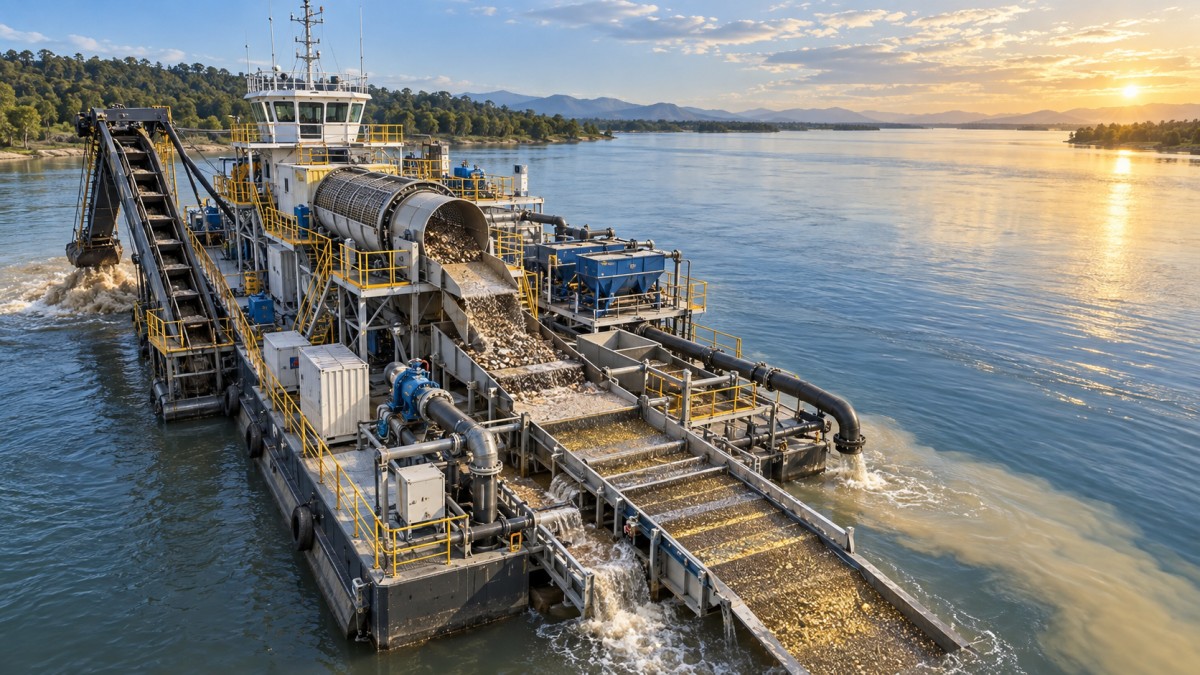
A practical onboard gravity circuit usually starts with excavation and feed delivery, then screening or trommel washing, followed by concentration equipment suited to the size range and mineral mix. Jigs and sluices are commonly used because they can handle high volumes and are compatible with floating operations, but they must be supplied with prepared feed and maintained at stable operating conditions. Where magnetic minerals are significant, magnetic separation may be added for a different recovery objective or to manage concentrate composition. It does not replace a gold recovery assessment.
The platform layout must leave enough working access for screen cleaning, mat or riffle inspection, jig maintenance, concentrate collection, and safe movement around pumps and drives. Access is not a minor fabrication detail. A recovery circuit that cannot be inspected during a shift will tend to run too long with blocked screens, worn components, poor water distribution, or misplaced discharge flows.
Water balance deserves early attention as well. Washing, classification, and gravity separation all depend on water, but excessive or poorly directed water can carry fine gold beyond the point of capture. The project team should define the source, recirculation approach where applicable, pump redundancy, slurry routing, and discharge arrangement before finalizing the platform. A nominally adequate processing plant can become unreliable when the water system cannot maintain the required pressure and flow through changing dredging conditions.
For example, a 100tph Bucket Chain Gold Dredger combines a bucket-chain dredging arrangement with a trommel, jig, fixed sluice, and gravity concentration section. Its stated configuration is relevant to projects evaluating integrated recovery in waterways with substantial clay and gravel, while its alternative pumping approach addresses softer terrain with less clay and gravel. The useful evaluation point is not the quoted 100 t/hr alone; it is whether the excavation depth, bucket sizing, screening capacity, and recovery equipment can operate as one controlled system at the expected feed condition.
Do not treat recovery figures as project recovery
Suppliers may state concentration ratios or recovery performance for a configured machine, and these figures can help compare equipment concepts. They should not be used as a direct forecast of recovered gold at a specific site. Project recovery includes losses before the recovery circuit, incomplete liberation, screen bypass, oversize losses, fine-gold losses, operating interruptions, maintenance condition, and crew adjustments. A plant described as capable of a high concentration ratio still requires site-specific test work and an operating plan.
For the same reason, adding more recovery stages is not always the right response to a recovery concern. Extra equipment adds weight, power demand, cleaning tasks, and failure points. If the underlying problem is inconsistent excavation, excessive clay, or poor feed distribution, additional concentrators may only receive the same poorly prepared material. The first improvement may be a better wash section, feed control, or a revised dredging sequence.
A decision should lead to an operating plan
Onboard gravity concentration is justified when it gives the project a controllable path from excavation to concentrate, rather than simply adding processing equipment to the deck. The best candidates are deposits where the gold can be liberated through washing, the recovery circuit can receive stable feed, and reducing bulk material movement has tangible operational value.
Before committing, project managers should require a deposit-based recovery assessment, a realistic mass balance, an onboard layout review, and a tailings-monitoring routine. Those steps turn dredge gold recovery from a capacity claim into a production decision that can be managed through changing ground conditions.
