











What water depth makes a small dredge practical for your project
A small dredge becomes practical when the available water is deep enough to float and operate the hull safely, while still allowing the suction head, cutter ladder, or excavation attachment to reach the target material at a productive angle. There is no single water-depth figure that decides the question. A pond with limited depth can suit a compact unit very well; a deeper river can still be a poor fit if the material lies beyond the working reach, access is restricted, or the discharge route is too long.
For project managers, the useful test is not “How deep is the water?” in isolation. It is whether the depth, water-level variation, bed elevation, material profile, and site access allow the dredge to maintain a stable working position and achieve the required output without excessive repositioning or support equipment.
Start with operating depth, not the deepest sounding
Water depth should be measured against the intended working area, including shallow approaches, turning points, anchoring locations, and the route needed to reach the deposit or maintenance section. The maximum depth recorded in a channel or pond is often irrelevant if the dredge must pass through a shallow entrance before it reaches that location.
For a floating small dredge, the first physical requirement is adequate clearance below the hull and pontoons. The machine must remain afloat through normal water-level changes, minor wave action, and local drawdown caused by pumping or nearby operations. If the hull repeatedly contacts the bed, operations slow down and damage risk rises quickly, particularly where submerged rock, timber, scrap, or uneven ground is present.
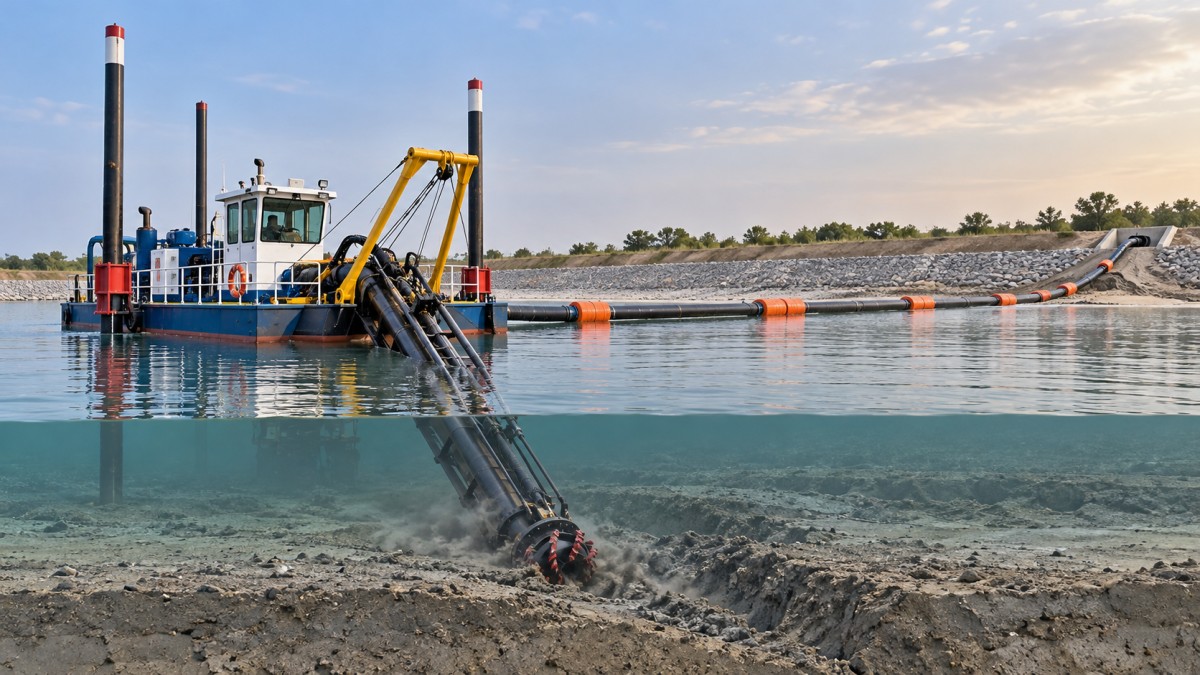
The second requirement is excavation reach. A cutter suction dredge, for example, needs its ladder to place the cutter head on the bed at a workable angle. If water is too shallow, the ladder can become too flat, reducing cutting control and making it harder to feed material consistently into the suction line. If the target material is too deep for the ladder, the dredge may float safely but still fail to reach the production zone.
A practical site review therefore separates three dimensions:
- Navigation depth: sufficient water for delivery, launching, movement, and positioning of the dredge.
- Working depth: water depth that allows the excavation tool or suction intake to work effectively at the bed.
- Deposit depth: the vertical distance from the operating water surface to the material that must actually be removed or recovered.
These values can differ significantly on a single project. A shallow-margin maintenance job may have enough water for a compact dredge near the centerline but require a different method for the last section close to shore.
When shallow water favors a small dredge
Compact dredging equipment is often a strong option in sheltered ponds, narrow canals, small harbors, sedimentation basins, mine ponds, and low-volume river maintenance areas where larger vessels cannot enter easily. Its lower draft, smaller transport footprint, and simpler launching requirements can reduce the amount of temporary site preparation.
Shallow water is favorable when the bottom material is accessible within the equipment’s working range and when the dredge can hold position without grounding. Fine sediment, loose sand, slurry, and relatively uniform alluvial material are generally easier to address in constrained water than mixed beds containing large boulders or heavily compacted clay.
However, “shallow” should not be confused with “almost dry.” A floating dredge still needs enough water beneath it to maneuver and enough surrounding water for stable pump intake conditions. In very shallow areas, an amphibious dredger, excavator-based method, land-based pump arrangement, or staged water-management plan may be more practical than forcing a conventional floating small dredge into the site.
Depth alone does not determine production
A common planning error is to approve a dredge because it can physically float at the site, then discover that production is limited by material transport rather than digging. A short, shallow cut can be handled effectively by a compact unit, but the same machine may become inefficient when slurry must travel a long distance uphill, through many bends, or across ground that requires frequent pipe relocation.
Pumping distance, discharge elevation, pipe diameter, and solids concentration affect the usable production rate. Dense sand and gravel generally demand more disciplined slurry handling than soft silt. A material profile with oversized rock can create blockages or require screening before the material reaches the pump system. Sticky clay may travel poorly as intact lumps and can trap valuable mineral particles during recovery work.
Water depth also interacts with anchoring. A small dredge working in an open pond may need anchor lines, spuds, winches, or shore-based points to sweep its working face in a controlled pattern. If the water is deep enough but the banks cannot provide reliable anchor positions, the dredge may lose accuracy and leave uneven cuts. In a narrow channel, limited room to swing the ladder or move anchors can matter more than the nominal depth.
Use the bed profile to decide whether compact equipment is enough
Before selecting a dredge, establish a simple depth-and-material profile across the intended work zone. It does not need to become a large survey exercise for every small project, but it should identify shallow ridges, sudden holes, the expected thickness of recoverable material, bank slopes, and obstacles. A single average water-depth figure can hide the conditions that determine whether a dredge spends its time producing or repositioning.
For mining projects, match water depth to the recovery flow
In alluvial or placer mining, the dredge should be evaluated as part of a recovery system rather than as an isolated machine. The water depth may be adequate for excavation, yet the project can still underperform if clay-bound feed reaches the processing plant without sufficient scrubbing, or if recovery equipment is unable to retain fine gold from the screened fraction.
Where a compact dredge feeds a mobile or modular wash circuit, the connection between dredging output and plant capacity deserves close attention. A processing line such as the 300tph Gold Washing Plant may be relevant where feed includes sticky clay, gravel, boulders, or tailings requiring re-concentration. Its value in the evaluation is not the stated capacity alone: managers should confirm that the dredge’s realistic slurry and solids delivery rate, screen sizing, water-recycling arrangement, and material characteristics support the selected recovery flow.
This matters especially at remote sites. A small dredge may be easier to mobilize and launch than a larger vessel, but poor access for fuel, pipe strings, water treatment, tailings handling, or plant maintenance can eliminate that advantage. The practical system is the one that can operate continuously within the site’s constraints, not simply the smallest machine that fits on the water.
A decision rule for the pre-selection stage
A small dredge is usually worth advancing to detailed selection when it can enter the site at the lowest expected operating water level, maintain safe flotation throughout the work area, reach the material without poor ladder geometry, and discharge slurry through a manageable pipeline route. It becomes less attractive when shallow access prevents stable operation, the deposit sits beyond its effective digging depth, or material conditions require more cutting force, screening, or recovery capacity than the compact system can support.
The most useful next step is to map the shallowest access point, the deepest required cut, the bed material zones, and the discharge location on one working drawing. That view normally reveals whether the project needs a small dredge, a larger dredging vessel, amphibious equipment, or a combined water-and-land processing arrangement.