











What Is a Bucket Chain Gold Dredger and How Does It Recover Placer Gold?
What Is a Bucket Chain Gold Dredger and How Does It Recover Placer Gold?
A Bucket Chain Gold Dredger is built for one job: digging placer-bearing material from underwater ground, feeding it steadily into a washing and recovery circuit, and separating gold from gravel, sand, and clay with as little loss as possible. If you are comparing recovery methods, this is the machine to understand when the deposit sits below water level and continuous excavation matters more than mobility.
In simple terms, the system combines excavation, lifting, screening, concentration, and tailings discharge on one floating platform. That sounds straightforward on paper. In the field, performance depends less on the name of the machine and more on whether the dredger matches the deposit, water conditions, feed size, and recovery target. That is where people often get it wrong.
Start with the actual mining situation, not the machine brochure
Before asking about capacity, ask what kind of placer gold deposit you are dealing with. A Bucket Chain Gold Dredger usually makes sense where the ore body is shallow to moderate in depth, laterally consistent, and submerged or waterlogged enough that floating mining is practical. If the pay layer is highly irregular, full of oversized boulders, or broken by hard compacted layers, the bucket chain may still work, but expected throughput needs a more cautious review.
- Check whether the gold is coarse, fine, or mixed. Recovery layout changes with particle size.
- Look at clay content. Sticky feed can reduce screening efficiency and increase gold loss.
- Confirm digging depth and water depth separately. People often mix these up.
- Identify oversize content early. Large rocks affect bucket wear, chain loading, and plant stability.
If those basics are still unclear, any production estimate is only a rough placeholder.
How the recovery process actually works
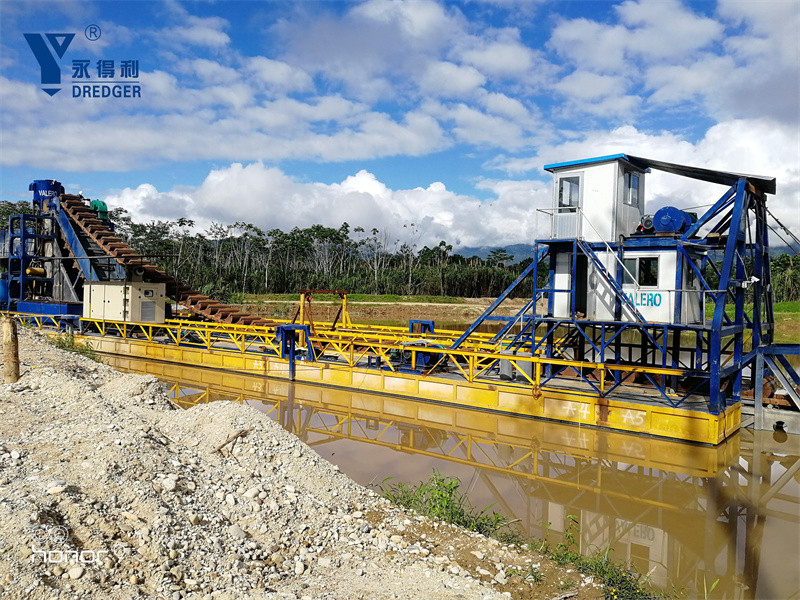
The bucket chain is the digging end. A continuous line of buckets cuts into the underwater deposit and lifts raw material up to the onboard processing section. From there, the material typically passes through a trommel or screen to separate oversize from finer slurry. The oversize is discarded or conveyed away, while the undersize containing heavy minerals moves into gold recovery equipment such as sluice systems, jigs, or other gravity concentration stages, depending on plant design.
That continuous feed is one of the main reasons this setup remains relevant. Intermittent feeding tends to upset gravity recovery. A stable feed rate usually helps maintain better separation, especially where gold distribution is fairly even. But steady feed only happens when the excavation side and the processing side are balanced. If the bucket chain outruns the wash plant, losses begin quietly and show up later in poor recovery.
What experienced buyers check before calling it “high recovery”
“High recovery” is easy to claim and hard to confirm without test work. Ask what recovery circuit is included, what size range it is intended for, and whether the supplier expects free gold only or also fine gold with black sand. That matters more than marketing language.
- Ask for the intended feed size after screening. Recovery equipment works within a practical range.
- Check whether clay disintegration is addressed. If not, gold may leave inside clay balls.
- Review how concentrate is cleaned up and how tailings are managed.
- If possible, compare the design against ore sample results or pilot testing. If no test data exists, treat recovery expectations as provisional.
This is especially important for information-stage buyers. Two dredgers can look similar and perform very differently if the recovery side is configured for different gold size distributions.
Do not separate excavation from flotation and pipeline support
A dredging system is only as stable as its floating support arrangement. On some projects, auxiliary floating components used around discharge lines, hoses, or support pipelines get treated as minor accessories. They are not minor when wave action, slurry density, or hose weight starts affecting line position and operating continuity. In broader dredging applications, a properly selected Floater helps keep marine pipelines, oil hoses, or cables on the surface and reduces problems caused by sinking or wave impact. Typical configurations in that product range cover pipe inner diameters from 200 mm to 900 mm, with net buoyancy values listed from 28 to 8180 KGS per float, but exact selection should still be matched to the line load and site condition.
Even if your main interest is gold recovery, stable floating infrastructure affects uptime more than many first-time buyers expect.
Where a Bucket Chain Gold Dredger usually fits well
This type of dredger is commonly considered when operators want a continuous mining platform for river, lake, pond, or flooded pit placer deposits. It is often compared with jet suction or cutter suction gold dredgers. The practical difference is in how the material is excavated and how well the system handles coarse gravel, compacted zones, and feed consistency.
The checks that prevent expensive surprises
People new to dredge-based placer mining usually focus on hourly capacity. Operators with some mileage tend to ask different questions.
- Can the bucket chain, screen, and recovery plant run at matched capacity without choking one another?
- What are the wear parts, and how available are they in the operating region?
- How is tailings discharged, and will that interfere with navigation, pond management, or reclamation planning?
- Is assembly, commissioning, and operator training included, or does the site team need to manage it?
- If the ore varies across the deposit, how easy is it to adjust screening and recovery settings?
For suppliers that cover R&D, fabrication, installation, commissioning, and project support, those service boundaries are worth reviewing early. Qingzhou Yongli Mining And Dredging Machinery Co., Ltd., for example, presents itself as a manufacturer integrating dredging vessels, mining equipment, installation, commissioning, project operation, and personnel allocation services. For a buyer still in the research stage, that matters because equipment success in placer mining often depends on support after delivery, not only on the machine itself.
A practical way to judge whether it belongs on your shortlist
Put the Bucket Chain Gold Dredger on your shortlist when the deposit is underwater, excavation needs to be continuous, feed has meaningful gravel content, and you want one platform to handle digging plus onboard recovery. Keep your expectations conservative if the ore body is poorly defined or test work is incomplete.
The best next step is not chasing the biggest quoted capacity. It is lining up a deposit description, sample data, expected gold size range, water conditions, and a realistic operating plan, then checking whether the proposed dredger and recovery circuit were designed around those facts. That is usually the difference between a machine that merely runs and one that actually recovers placer gold efficiently.