











How to assess spare-parts support from dredger sellers
A dredger can be mechanically sound and still become a costly liability if a failed pump part, seal, hose, bearing, or hydraulic component cannot be identified and supplied quickly. When comparing dredger sellers, procurement teams should treat spare-parts support as part of the equipment package, not as an after-sales promise to review after purchase.
The practical question is simple: can the supplier help your team restore operation when a normal wear item or an unexpected failure stops the job? A credible answer requires evidence on parts identification, stock availability, logistics, technical support, and commercial terms.
Start with the parts that can stop the dredger
Do not ask a seller only whether “spare parts are available.” That question is too broad to be useful. Request a machine-specific recommended spare-parts list and divide it by operational impact.
This list should match the exact dredger configuration being quoted. Generic catalog pages are not enough. A customized vessel may use a different engine, pump size, electrical cabinet, winch, or attachment from the seller’s standard model, and those differences must appear in the final documentation.
Assess documentation before assessing inventory
Inventory is only useful when the supplier can accurately identify the required item. Ask to see a sample parts manual, assembly drawing, hydraulic diagram, and electrical schematic for a comparable unit. The documents should connect each component to a clear reference number, specification, and location on the machine.
Pay attention to how the seller handles bought-in components such as engines, hydraulic pumps, motors, bearings, and electrical devices. A reliable supplier should disclose the make and model where relevant, rather than hiding all information behind an internal code. This gives the buyer a practical path to source certain standard items locally when project conditions make overseas shipment impractical.
However, local sourcing is not always the answer. Wear components made to the dredger manufacturer’s geometry, custom impellers, structural attachments, and machine-specific control parts may not be interchangeable. Ask which items are proprietary, which are standard industrial components, and which alternatives have been approved for use.
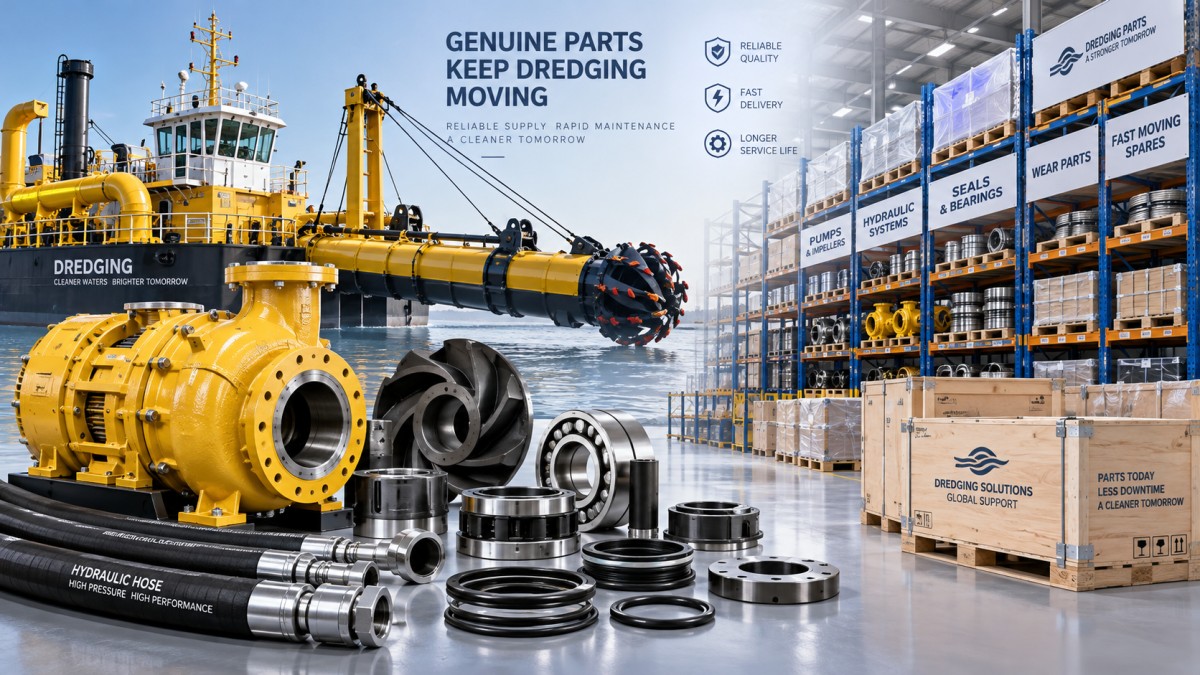
Test the seller’s response process, not just its promise
Spare-parts capability is operational. During evaluation, send the same realistic request to each shortlisted supplier: identify a named critical component from a drawing or sample parts list, request a quotation, and ask what information they need before dispatch. Their response will reveal whether the after-sales team has an organized process.
A useful response should include more than a price. It should confirm the part number, quantity, compatibility with the offered dredger, packing method, expected dispatch condition, and any installation-related guidance. Slow or vague replies before the order are often a warning that urgent support after delivery will also be difficult.
Ask who owns the case after a failure is reported. Sales staff may remain involved, but a technical contact with authority to identify parts and coordinate shipment is more important. For projects in remote waterways, wetlands, mining sites, or ports, clarify the communication route outside normal office hours and the information your crew must provide: serial number, photographs, operating symptoms, pressure readings, or video of the fault.
Check stock strategy against your project risk
There is no single “good” inventory level. The right arrangement depends on the cost of downtime, site accessibility, material conditions, and shipping distance. A dredger working on a short urban canal maintenance contract can often rely on rapid delivery for routine items. A vessel deployed at an isolated mining or flood-prevention site needs a larger on-site critical-spares package because transport delays can disrupt the entire work sequence.
Ask the seller to distinguish between:
- parts normally held in its own warehouse;
- items obtained from upstream manufacturers;
- custom parts manufactured to order;
- recommended commissioning and first-season spares; and
- long-lead components worth purchasing before mobilization.
Do not automatically buy every suggested spare. That ties up cash and may leave you with parts that degrade in storage or never fit a later configuration. Instead, build a site kit around failure consequence. Include low-cost items that can halt the machine, wear parts linked to the expected slurry or sediment, and components with difficult replenishment routes. High-value assemblies can remain supplier-held when the seller provides a credible availability and response plan.
Special attention for multi-function and amphibious equipment
Spare-parts assessment becomes more demanding when one machine performs several roles. For example, an Amphibious Dredger used in wetland restoration, industrial pond desilting, or shallow construction may move on tracks, work afloat, and use different attachments for dredging, excavation, or piling. The parts plan must cover the base machine as well as the attachment interfaces, hydraulic connections, track system, pontoons, and stabilizing equipment.
In this case, ask whether the parts book separates common chassis parts from attachment-specific components. Also confirm whether changing attachments requires different hoses, couplings, pins, seals, control settings, or consumables. A seller that can provide one complete and traceable configuration record reduces the risk of ordering the right part for the wrong working arrangement.
Read commercial terms as part of spare-parts support
Good technical support can still fail commercially if terms are unclear. The purchase contract and parts agreement should state the warranty scope, the method for submitting a claim, responsibilities for diagnosis, and how replacement parts are priced after warranty. It should also clarify packing, shipment responsibility, export documentation, and whether technical assistance is included when a supplied part does not resolve the fault.
Be cautious when the equipment price appears unusually attractive but the seller will not provide a priced spare-parts schedule. Initial savings can disappear if routine replacement items are expensive, difficult to identify, or available only through a slow approval process.
A practical decision sequence
- Define the project’s downtime tolerance and site logistics before requesting quotations.
- Require each seller to submit a machine-specific critical-spares and consumables list.
- Review sample manuals and drawings for part-number clarity and configuration control.
- Check which components are stocked, sourced externally, or made to order.
- Test technical responsiveness with a realistic parts-identification request.
- Compare the proposed on-site kit, supply process, documentation quality, and contract terms alongside the dredger price.
The strongest supplier is not necessarily the one claiming to hold every item in stock. It is the one that can show how a part is identified, where it comes from, how quickly it can move, and who will support the repair. That evidence gives procurement teams a more defensible basis for choosing among dredger sellers and protects the operating schedule long after delivery.